
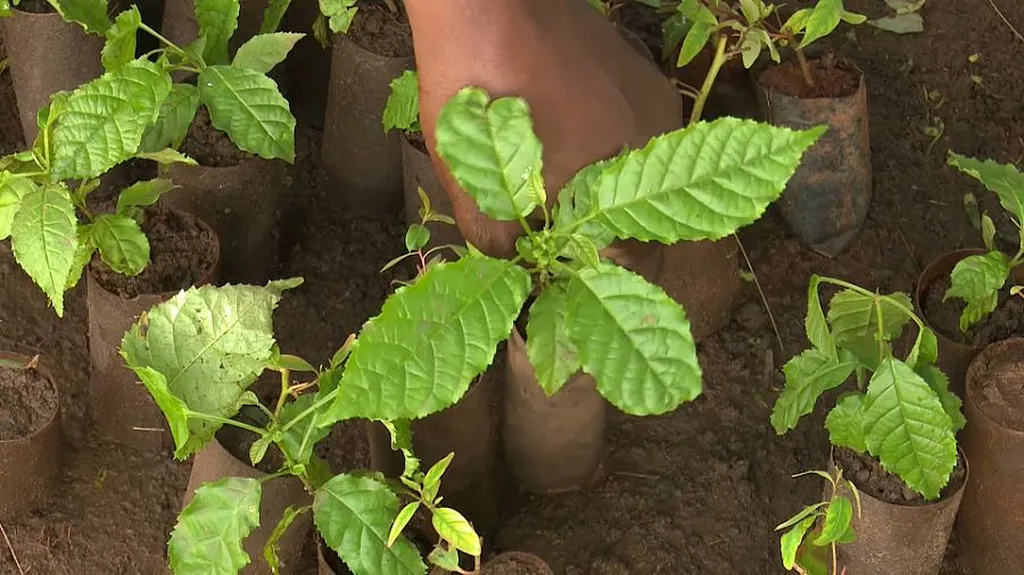
In a significant stride towards sustainability, researchers have developed biodegradable seedling pots using agricultural waste, offering a promising alternative to conventional plastic containers. This innovation, published in *Research in Agricultural Engineering*, could reshape the agricultural sector’s approach to circular bioeconomy and waste management.
The study, led by Joseph Kofi Conduah from the Department of Agricultural and Mechanical Engineering at the University of Cape Coast, Ghana, explores the potential of sawdust (SD) and spent mushroom compost (SMC) in creating eco-friendly seedling pots. The researchers experimented with four different ratios of SMC to SD, evaluating their mechanical properties, structural characteristics, and water absorption capacity.
The findings revealed that the 60:40 ratio of SMC to SD exhibited optimal performance, boasting superior water absorption capacity, indirect tensile strength, and structural properties. “The 60:40 ratio showed a balanced combination of strength and water retention, making it ideal for seedling growth,” Conduah explained. Notably, the 70:30 ratio also demonstrated comparable tensile strength, while higher SMC content significantly enhanced root development.
The implications for the agriculture sector are substantial. By converting agricultural waste into biodegradable seedling containers, farmers can reduce their dependency on plastic pots, mitigating environmental pollution and cutting costs. “This research presents a viable solution for turning agricultural waste into valuable resources,” Conduah stated. The use of biodegradable pots can also improve soil health, as they decompose naturally without leaving harmful residues.
The study’s insights into root system architecture, analyzed using ImageJ and WinRHIZO software, provide a deeper understanding of how different pot compositions influence plant growth. This knowledge could inform future developments in plant cultivation techniques and materials science.
As the agricultural sector increasingly prioritizes sustainability, innovations like biodegradable seedling pots are poised to play a crucial role. By embracing circular bioeconomy principles, farmers and agribusinesses can reduce waste, lower costs, and contribute to a healthier environment. The research led by Conduah and his team offers a compelling example of how agricultural waste can be transformed into functional, eco-friendly products, paving the way for a more sustainable future in agriculture.