
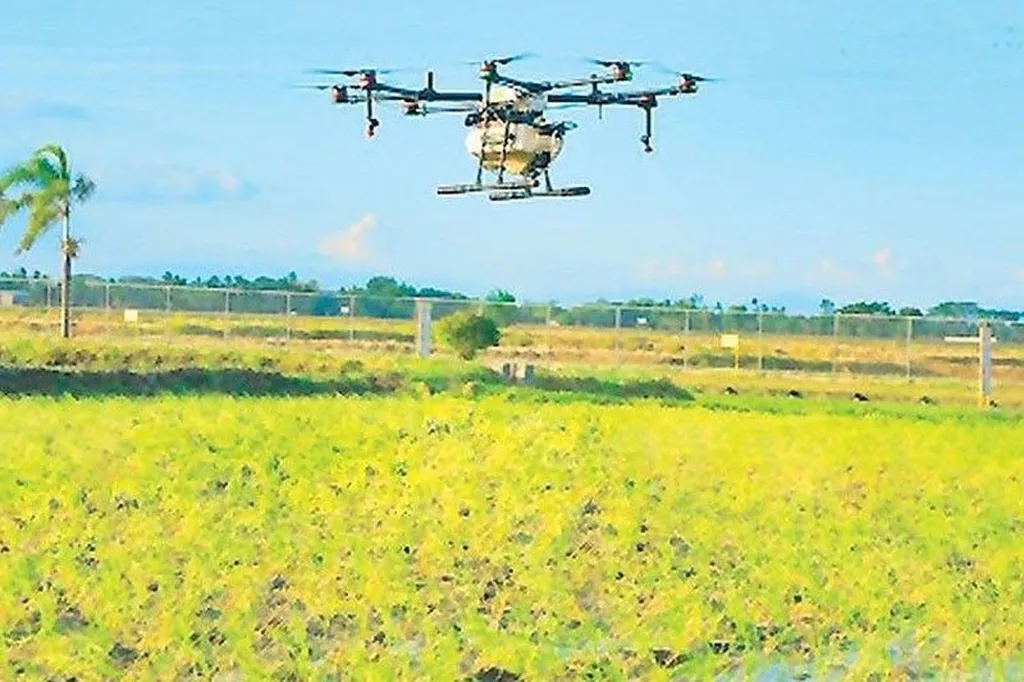
In the heart of Malaysia, a groundbreaking study is transforming how farmers tackle one of rice cultivation’s most persistent challenges: broadleaf weed infestation. Researchers, led by Nursyazyla Sulaiman from the Department of Agriculture Technology at Universiti Putra Malaysia, have harnessed the power of unmanned aerial vehicles (UAVs) and machine learning to detect and classify weeds with unprecedented accuracy. Their work, published in *Frontiers in Plant Science*, could revolutionize precision agriculture and bolster rice yields worldwide.
The study focused on three notorious broadleaf weeds—Monochoria vaginalis, Limnocharis flava, and Sphenoclea zeylanica—that plague rice fields, particularly during the early vegetative stages when competition for resources is most intense. Traditional methods of weed detection often fall short, leading to delayed interventions and significant yield losses. However, the team’s innovative approach promises to change this narrative.
Using a DJI Matrice 600 UAV equipped with a Resonon Pika L hyperspectral camera, the researchers captured detailed imagery of a 1-hectare rice plot near Perak, Malaysia. The hyperspectral data, collected at various altitudes, were then analyzed using ENVI Classic 5.3 software. The team employed three machine learning algorithms—Support Vector Machine (SVM), Minimum Distance (MD), and Parallelepiped (PP)—to classify the weed species at 15, 25, and 30 days after sowing.
The results were staggering. SVM consistently outperformed the other algorithms, achieving over 99% classification accuracy for all weed species across all growth stages. “The high accuracy of SVM is a game-changer,” Sulaiman explained. “It minimizes both omission and commission errors, ensuring that farmers can take targeted action with confidence.”
The implications for the agriculture sector are profound. Early and accurate detection of weeds allows for timely and precise application of herbicides or other control measures, reducing costs and environmental impact. “This methodology supports precision agriculture by enabling timely and targeted weed management strategies,” Sulaiman noted. “Ultimately, this can improve rice yield and sustainability.”
The study also revealed intriguing trends in vegetation cover. As the days progressed, broadleaf weed cover expanded, while rice cover fluctuated and soil cover declined. This data underscores the competitive dominance of weeds and the critical need for early intervention.
Looking ahead, the integration of UAV hyperspectral imaging and machine learning holds immense potential for the future of agriculture. “This research paves the way for scalable, accurate, and efficient weed detection systems,” Sulaiman said. “It’s not just about improving yields; it’s about creating a more sustainable and resilient agricultural ecosystem.”
As the world grapples with the challenges of climate change and food security, innovations like these offer a beacon of hope. By leveraging cutting-edge technology, farmers can stay ahead of the curve, ensuring bountiful harvests and a healthier planet. The study by Sulaiman and her team is a testament to the power of interdisciplinary research and its potential to transform the agricultural landscape.