
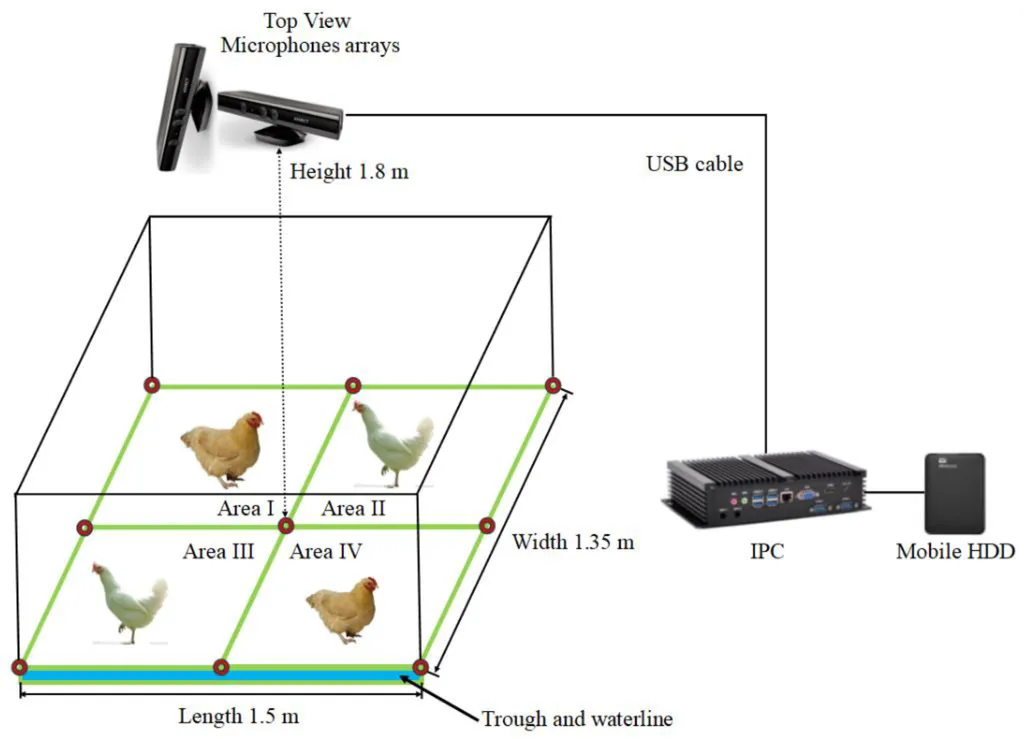
In the rapidly evolving world of precision agriculture, a groundbreaking study published in the *Journal of Agricultural Engineering* is set to revolutionize how farmers monitor the health of their livestock. Researchers, led by Bowen Sun from the College of Computer and Information Engineering at Tianjin Agricultural University, have developed a sophisticated method for early detection of health issues in white-feathered broilers by analyzing their vocalizations. This innovative approach could significantly enhance on-farm monitoring and management practices, offering a non-invasive and automated solution for poultry farmers.
The study focuses on the acoustic characteristics of normal and abnormal calls in broilers, providing a novel framework for identifying non-healthy conditions. By collecting vocalizations from 2-week-old broilers over a 21-day period, the researchers analyzed a range of time-domain and frequency-domain features, including maximum amplitude, effective amplitude, fundamental frequency, and pulse index. Their findings revealed significant differences between normal calls and those influenced by laryngeal mucus, a common indicator of respiratory issues.
“Our research demonstrates that acoustic analysis can be a powerful tool for early detection of health problems in broilers,” said Bowen Sun. “By leveraging advanced machine learning techniques, we achieved remarkable accuracies of 97.8% with support vector machines and 98.76% with random forest classifiers. This method not only enhances the interpretability of the data but also provides a practical solution for on-farm monitoring.”
The implications of this research for the agriculture sector are profound. Traditional methods of health monitoring in poultry farming often rely on visual inspections and manual observations, which can be time-consuming and prone to human error. The proposed acoustic analysis framework offers a more efficient and accurate alternative, enabling farmers to detect abnormal signs at an early stage and take timely action. This can lead to improved animal welfare, reduced mortality rates, and increased productivity, ultimately benefiting the entire poultry industry.
Moreover, the study’s emphasis on statistically validated feature selection, aligned with physiological mechanisms, sets it apart from previous empirical feature aggregation methods. This approach enhances the reliability and performance of the model, making it a robust tool for precision poultry farming. As the agriculture sector continues to embrace technological advancements, the integration of acoustic analysis into routine farm management practices could become a standard procedure.
The research also opens up new avenues for future developments in the field. As Bowen Sun noted, “This framework can be extended to other livestock species, paving the way for a more comprehensive and integrated approach to animal health monitoring.” The potential applications of acoustic analysis in agriculture are vast, and this study serves as a stepping stone for further innovations in precision farming.
In conclusion, the study by Bowen Sun and his team represents a significant advancement in the field of agricultural technology. By harnessing the power of acoustic analysis and machine learning, farmers can now monitor the health of their broilers more effectively and efficiently. This not only improves animal welfare but also contributes to the overall sustainability and profitability of poultry farming. As the agriculture sector continues to evolve, the integration of such innovative technologies will be crucial in meeting the growing demand for food while ensuring the well-being of livestock.