
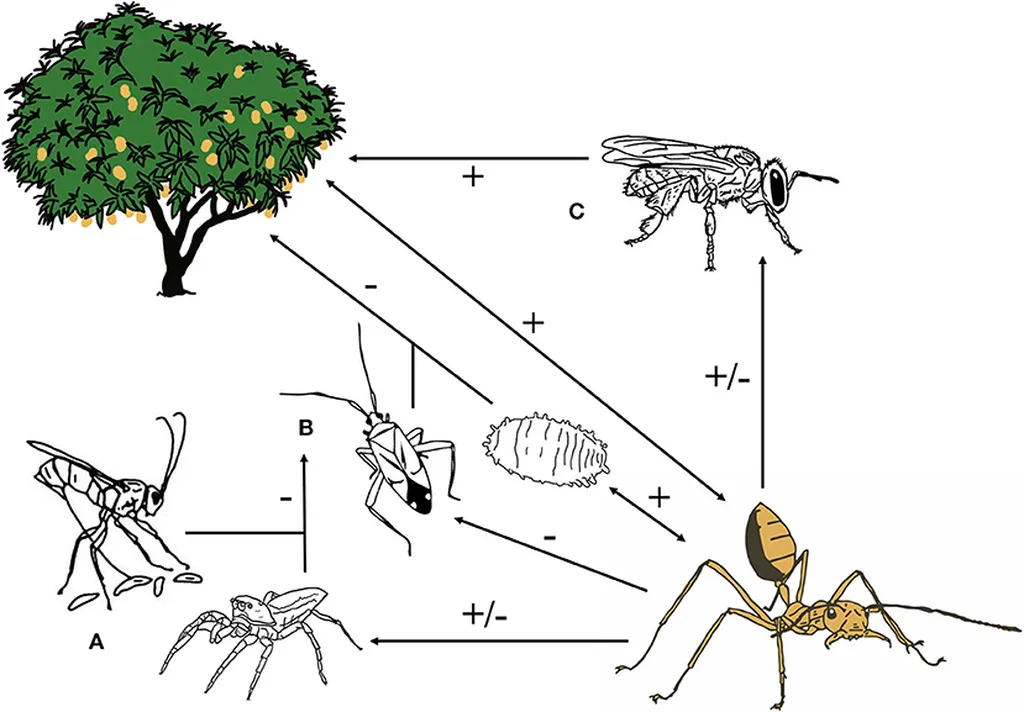
In the lush citrus orchards of Tanzania’s Handeni District, a tiny, industrious creature is making waves in the world of pest management. The humble weaver ant (Oecophylla longinoda) is at the heart of a groundbreaking study published in the International Journal of Agricultural Sustainability, which reveals that these ants could be a game-changer for smallholder farmers looking to ditch chemical insecticides.
The study, led by William George of the Department of Economics at the University of Dodoma, conducted over two growing seasons with 20 smallholder farmers, found that weaver ant-based pest control not only significantly reduced costs but also increased yields. The economic analysis, using Gross Margin Analysis and Benefit-Cost Ratio, showed that farmers could achieve higher market prices for their citrus fruits due to consumer preference for pesticide-free produce.
“This study demonstrates that weaver ants are not just a sustainable alternative to chemical insecticides, but also a cost-effective one,” said George. “The economic benefits are clear, and the environmental and health benefits are even more significant.”
The shift from chemical to biological pest control is not just a win for the environment and public health, but also for the farmers’ bottom line. The study highlights that the reduced costs of pest management, coupled with increased yields and higher market prices, make weaver ant-based control a viable and attractive option for smallholder farmers.
The implications of this research extend far beyond the citrus orchards of Handeni. As the world grapples with the challenges of sustainable agriculture, this study offers a promising solution that is both regionally relevant and globally applicable. The use of weaver ants could pave the way for a new era of eco-friendly pest management strategies, particularly in sub-Saharan Africa.
“This research is a testament to the power of looking to nature for solutions,” said George. “The weaver ant is a remarkable creature, and its potential for pest management is just beginning to be understood.”
As the agriculture sector continues to evolve, the integration of biological control methods like weaver ant strategies could become a cornerstone of sustainable farming practices. The economic feasibility and environmental benefits make it a compelling alternative to traditional chemical insecticides, offering a glimpse into a future where agriculture is not just productive but also harmonious with nature.
The study’s findings, published in the International Journal of Agricultural Sustainability, underscore the importance of investing in research that explores innovative, sustainable solutions for the challenges facing modern agriculture. As the world looks to feed a growing population while minimizing environmental impact, the humble weaver ant might just be the unsung hero of the agriculture sector.