
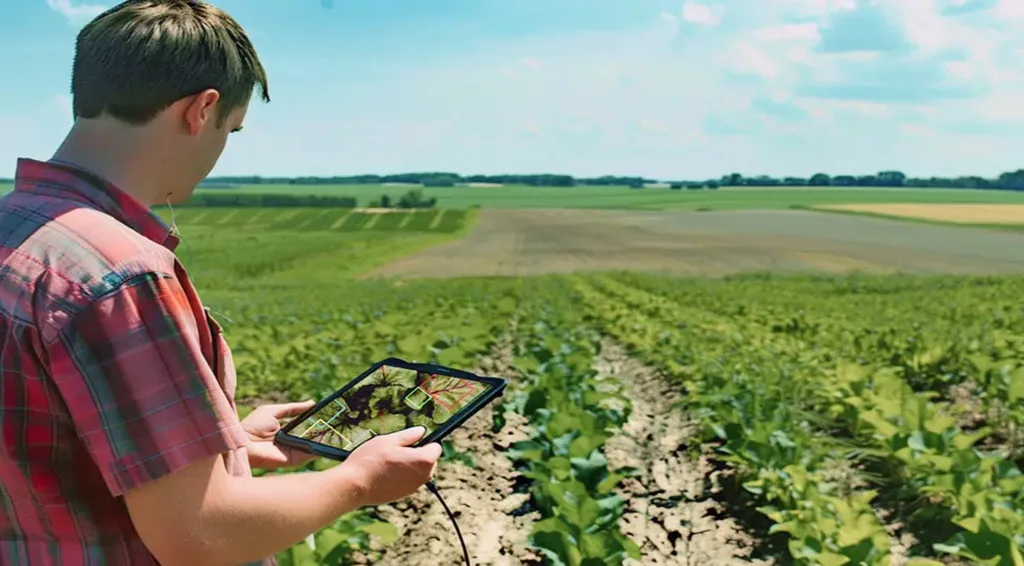
In the rapidly evolving landscape of precision agriculture, a novel approach to vegetation segmentation has emerged, promising to enhance the efficiency and accuracy of agricultural monitoring. Researchers have developed a pixel-wise segmentation method that leverages the Common Vector Approach (CVA) to analyze color regions in vegetation canopy images. This innovative technique, published in *Acta Scientiarum: Technology*, represents a significant advancement in the application of image processing and machine learning in agriculture.
The study, led by Umit Cigdem Turhal from Bilecik Seyh Edebali University, introduces a method that manually crops color regions of vegetation and soil, then encodes these regions into 3rd order color tensors. By unfolding these tensors, a 2-D color matrix is obtained, which is then analyzed using CVA to derive a common color vector. This vector represents the common properties of the color region and is used for segmentation purposes.
The implications for the agriculture sector are substantial. Precision agriculture relies heavily on accurate and efficient monitoring of vegetation to optimize yield, save energy, and reduce time consumption. The proposed method offers a robust tool for segmenting vegetation canopies, which can be integrated into various agricultural applications, from drone-based monitoring to automated harvesting systems.
“Our method achieves extremely high performance compared to deep learning techniques like Convolutional Neural Networks (CNN),” stated Turhal. “This is particularly evident in our experimental studies where dataset combinations included two of the datasets used in previous research.”
The study utilized two different datasets proposed for open computer vision tasks in precision agriculture. Three experimental studies were conducted with different dataset combinations for training and test sets. The results demonstrated that the proposed method outperformed CNN-based semantic segmentation methods, especially in scenarios involving multiple datasets.
The commercial impact of this research could be profound. Farmers and agricultural companies stand to benefit from more accurate and efficient monitoring systems, leading to improved resource management and increased productivity. The integration of this segmentation technique into existing precision agriculture technologies could revolutionize the way crops are monitored and managed.
As the field of precision agriculture continues to evolve, this research paves the way for future developments in image processing and machine learning applications. The use of 3rd order tensors and statistical pattern recognition techniques offers a promising avenue for enhancing the accuracy and efficiency of agricultural monitoring systems.
In the words of Turhal, “This method not only improves the segmentation of vegetation canopies but also opens up new possibilities for the application of advanced image processing techniques in agriculture.”
With the growing demand for sustainable and efficient agricultural practices, this research represents a significant step forward in the integration of technology and agriculture, shaping the future of precision farming.