
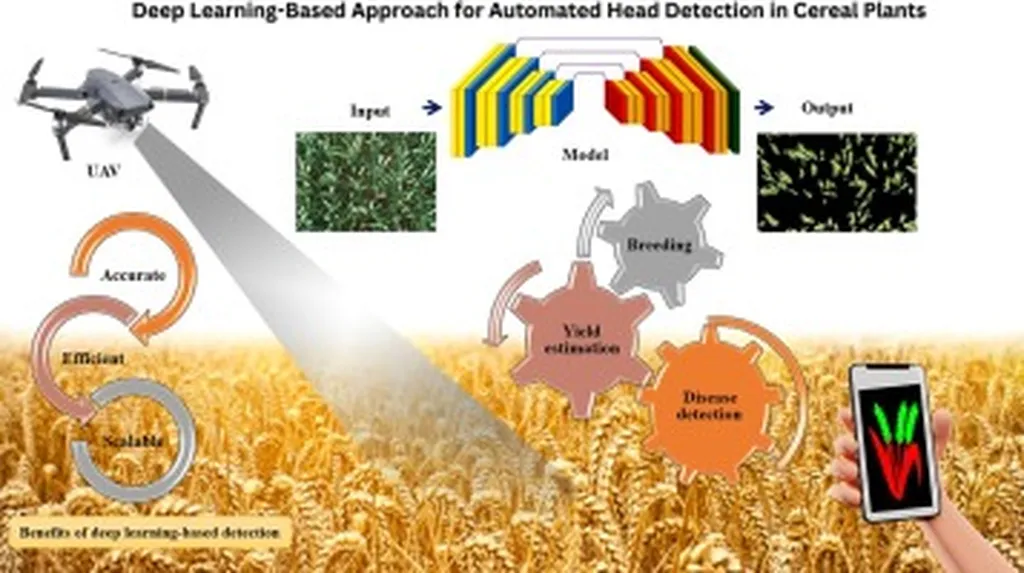
In the rapidly evolving world of precision agriculture, the ability to accurately model and understand plant structures is becoming increasingly crucial. A recent study published in *Frontiers in Plant Science* introduces a groundbreaking method that could revolutionize how we approach 3D plant modeling, particularly in the realm of point cloud completion. The research, led by Zhiming Wei from the Nanjing Institute of Agricultural Mechanization, Ministry of Agriculture and Rural Affairs, presents a novel deep learning framework designed to address the challenges of incomplete or noisy LiDAR data.
LiDAR technology has long been a cornerstone in various fields, from autonomous navigation to infrastructure inspection. However, its application in agriculture often faces hurdles due to environmental disturbances and sensor limitations, which can result in incomplete or noisy point clouds. These imperfections can degrade the performance of downstream tasks, such as autonomous navigation and high-precision 3D modeling.
The study introduces the Multi-Resolution Completion Net (MRC-Net), an unsupervised deep learning framework that leverages a Generative Adversarial Network (GAN) inversion strategy combined with multi-resolution principles. This innovative approach aims to provide robust, high-fidelity point cloud completion under practical conditions.
“Our method integrates a multi-resolution degradation mechanism that guides reconstruction across coarse-to-fine scales, and a multi-scale discriminator that captures both global structure and local details,” explains Wei. This dual approach enables MRC-Net to achieve accuracy comparable to leading supervised approaches, without the need for extensive labeled data.
The results are impressive. On virtual datasets, MRC-Net attains an average Chamfer Distance (CD) of 8.0 and an F1 score of 91.3. When applied to a custom dataset targeting agricultural scenarios, the model demonstrates its versatility. For regular cartons, it achieves a CD of 3.3 and an F1 score of 97.3, while for structurally complex simulated plants, it maintains overall shape with an average CD of 8.6 and an F1 score of 88.1.
The implications for the agriculture sector are significant. Accurate 3D plant modeling can enhance autonomous navigation for agricultural robots, improve high-precision 3D modeling, and contribute to better data quality in precision agriculture. “This method provides a reliable data foundation for downstream tasks, thereby contributing to improved data quality in precision-agriculture and related domains,” Wei adds.
The study’s findings suggest that MRC-Net could shape future developments in the field by offering a more reliable and efficient way to handle incomplete or noisy LiDAR data. As the agriculture industry continues to embrace technology, the ability to accurately model and understand plant structures will be paramount. This research not only advances the state-of-the-art in point cloud completion but also paves the way for more innovative applications in precision agriculture.
In an era where data is king, the ability to process and interpret it accurately is a game-changer. The work of Zhiming Wei and his team represents a significant step forward in this direction, offering a glimpse into a future where technology and agriculture intersect to create more efficient, sustainable, and productive farming practices.