
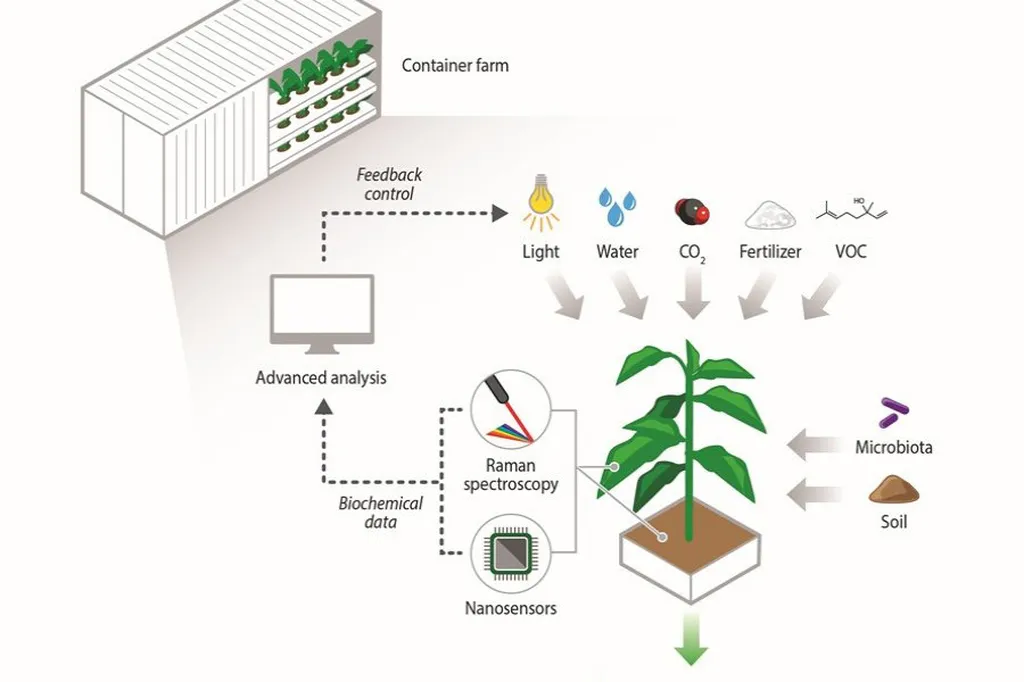
In the ever-evolving landscape of agricultural technology, a groundbreaking study has emerged that could revolutionize how we monitor and manage crops. Researchers have turned to Raman spectroscopy, a technique that provides molecular-level insights into plant tissues, to discern subtle biochemical variations in vegetation. This innovation, detailed in a recent publication in the *ISPRS Annals of the Photogrammetry, Remote Sensing and Spatial Information Sciences*, offers a promising tool for precision agriculture and environmental management.
The study, led by S. Kumar from the Indian Institute of Remote Sensing (IIRS), ISRO, Dehradun, India, focused on capturing Raman spectra from two distinct leaf samples using a 532 nm excitation source. The results revealed three prominent peaks corresponding to carotenoid molecules, which are vital for photosynthesis. Notably, Leaf 1 exhibited higher peak intensities, indicating a greater concentration of carotenoids and potentially higher photosynthetic activity.
“This technique allows us to detect biochemical changes in plants long before they become visible,” Kumar explained. “It’s like having an early warning system for crop health, which can be invaluable for farmers and agricultural managers.”
The implications for the agriculture sector are profound. Raman spectroscopy can serve as an early detection tool for nutrient deficiencies and other health issues in crops, enabling farmers to take corrective actions before yields are affected. This proactive approach can enhance crop productivity and sustainability, ultimately contributing to food security.
Beyond the field, Raman spectroscopy also holds promise for forestry and environmental monitoring. By creating comprehensive spectral libraries, researchers can classify diverse plant species in ecologically rich environments. This capability is crucial for biodiversity conservation and ecosystem management.
From a geospatial perspective, Raman spectroscopy can calibrate satellite-derived vegetation indices, improving the accuracy of machine learning models. When integrated with Geographic Information Systems (GIS) platforms, field-portable Raman devices can generate detailed biochemical maps. These maps can facilitate multi-scale vegetation monitoring, leveraging the strengths of UAVs and satellite sensors.
The choice of a 532 nm laser is particularly significant, as it enhances sensitivity to carotenoids, making Raman spectroscopy exceptionally well-suited for studying green vegetation. This innovation could pave the way for more nuanced and effective monitoring of both natural ecosystems and cultivated landscapes.
As the agriculture sector continues to embrace technology, the integration of Raman spectroscopy into precision agriculture practices could mark a significant leap forward. By providing real-time, molecular-level insights, this technique offers a powerful tool for informed, climate-smart decision-making in agricultural and environmental management.
In the words of Kumar, “This is just the beginning. The potential applications of Raman spectroscopy in agriculture and environmental science are vast, and we are excited to explore them further.”
With ongoing advancements in technology and data analysis, the future of vegetation monitoring looks brighter than ever. The research led by Kumar and his team at IIRS, ISRO, Dehradun, India, published in the *ISPRS Annals of the Photogrammetry, Remote Sensing and Spatial Information Sciences*, is a testament to the innovative spirit driving the field forward. As we continue to unravel the complexities of plant biochemistry, the possibilities for enhancing agricultural practices and environmental stewardship are limitless.