
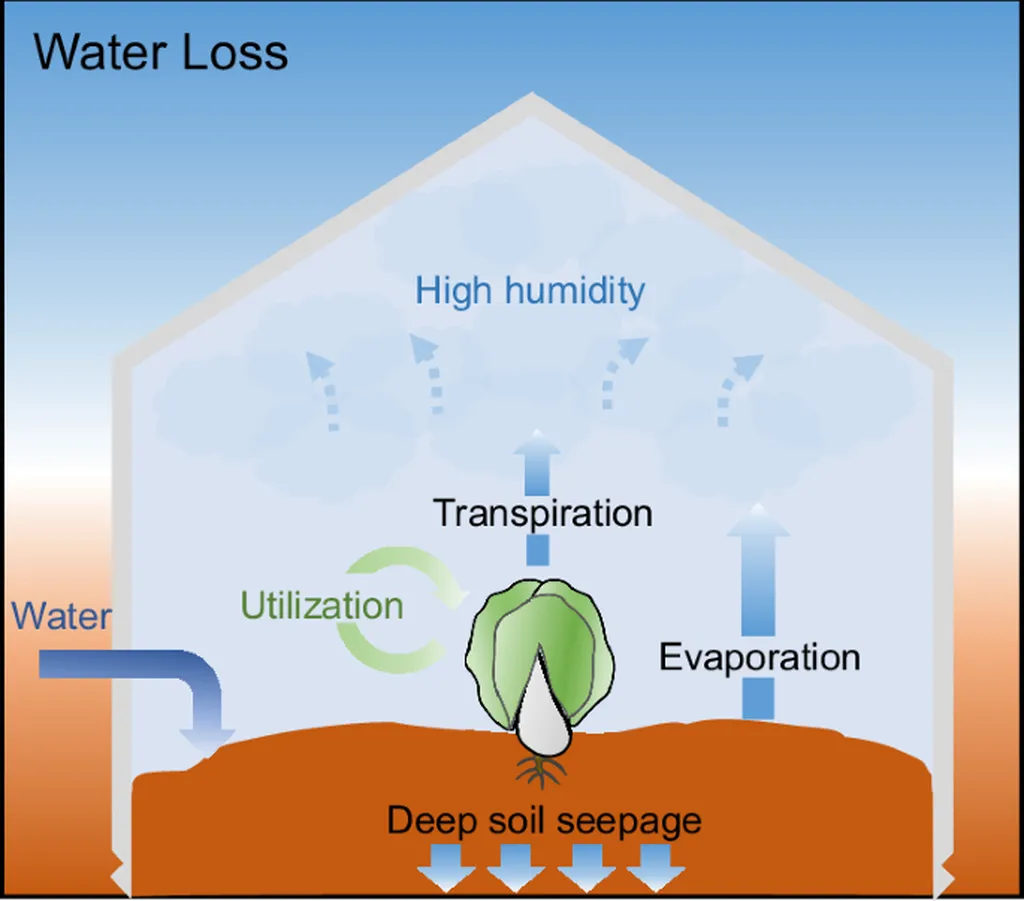
In the heart of agricultural innovation, a new study is making waves by refining the way farmers and agronomists estimate crop water use, a critical factor in efficient water management. Published in the *International Journal of Agronomy*, the research led by Maria C. Capurro from the Department of Soil and Crop Sciences delves into the history and progress of developing basal crop coefficients (Kcb) for estimating evapotranspiration (ET), the process of water loss through soil evaporation and plant transpiration.
Evapotranspiration is a complex interplay of weather, crop type, and management practices. Accurate estimation of ET is vital for optimizing irrigation strategies, conserving water, and enhancing crop productivity. The study highlights the evolution of the two-step approach to estimating ET, which involves calculating reference evapotranspiration (ETref) and applying a crop coefficient (Kc). The dual Kc approach, which separates Kc into Kcb and a soil evaporation coefficient (Ke), offers a more nuanced understanding of crop water use.
“Using standard Kcb values is preferred over mean Kc values because differences in agricultural practices can change the partition of the crop water use between transpiration and soil evaporation,” Capurro explains. This distinction is crucial for tailoring irrigation practices to specific crops and conditions, ultimately leading to more efficient water use.
The research underscores the advantages of the dual Kc approach, particularly in its ability to provide more accurate and transferable Kcb values under standard conditions. These conditions, as defined by the Food and Agriculture Organization (FAO) and the American Society of Civil Engineers (ASCE), include uniform, actively growing vegetation without water stress or disease, and with adequate fetch. By adhering to these standards, farmers and agronomists can apply Kcb values across different locations, enhancing the consistency and reliability of their water management strategies.
The study also explores contemporary approaches for deriving and adjusting Kcb curves according to actual crop growth. Advances in field instrumentation and spectral reflectance technologies are paving the way for more precise and dynamic estimation of crop water needs. As Capurro notes, “Quantifying plant transpiration using Kcb is a valuable approach in estimating ETc as part of effective agricultural water management.”
The implications for the agriculture sector are significant. By refining the estimation of evapotranspiration, farmers can optimize irrigation schedules, reduce water waste, and improve crop yields. This is particularly relevant in regions facing water scarcity and climate variability, where efficient water management is paramount.
Looking ahead, the study suggests that continued advancements in sensor, computing, and remote sensing technologies will further enhance the derivation and use of Kcb curves. These innovations promise to revolutionize agricultural water management, making it more precise, efficient, and sustainable.
As the agriculture sector grapples with the challenges of climate change and resource constraints, the insights from this research offer a beacon of hope. By harnessing the power of technology and data, farmers can navigate the complexities of crop water use and cultivate a more resilient and productive future.