
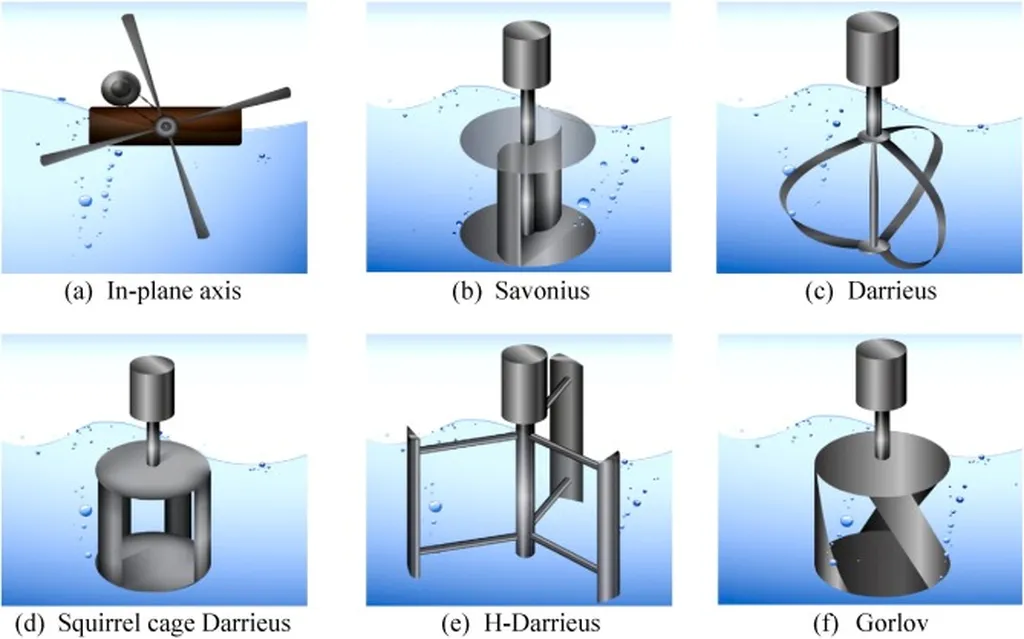
In the quest for sustainable energy solutions, researchers are increasingly turning their attention to hydrokinetic systems, particularly those designed for low-flow water environments. A recent study published in the *BIO Web of Conferences* delves into the computational fluid dynamics (CFD) of Savonius water turbines, offering promising insights for the agricultural sector. Led by Anugrah Rinasa Agistya from the Department of Automotive Engineering Technology at the Faculty of Engineering, the research explores how these turbines could revolutionize energy efficiency in agricultural applications.
Savonius water turbines are renowned for their self-starting capabilities and simple construction, making them ideal for hydrokinetic pico hydro systems. These systems harness energy from low-flow water sources, a resource often overlooked but abundant in many regions. The study focuses on a four-bladed Savonius water turbine, utilizing Ansys Fluent 2024 RI software to simulate its performance under various inlet velocities.
The research involved creating a detailed three-dimensional model of the turbine, divided into over 2.7 million small parts to ensure simulation accuracy. The team tested five different inlet velocities—0.5 m/s, 0.75 m/s, 1.0 m/s, 1.25 m/s, and 1.5 m/s—to observe their effects on flow shape, flow path, and turbulence levels. The findings revealed that higher inlet velocities significantly increase speed variation, flow complexity, and turbulence, particularly in the central area of the turbine. Conversely, lower velocities maintain a more stable flow with minimal separation.
“This study highlights the potential of Savonius water turbines to enhance energy efficiency in agricultural settings,” said Agistya. “By optimizing these turbines for low-flow environments, we can reduce operational costs and carbon emissions, making them a viable option for irrigation pumps, smart farming systems, and post-harvest processing.”
The implications for the agricultural sector are substantial. Hydrokinetic pico hydro systems could provide a sustainable energy source for irrigation, reducing reliance on fossil fuels and lowering operational costs. Smart farming systems, which require consistent energy supply for sensors and automation, could also benefit from this technology. Additionally, post-harvest processing, a critical yet energy-intensive phase in agriculture, could see significant improvements in efficiency and sustainability.
The research not only sheds light on the current capabilities of Savonius water turbines but also paves the way for future developments. As Agistya noted, “Understanding the fluid dynamics of these turbines allows us to design more efficient and robust systems tailored to specific agricultural needs.” This could lead to innovations in turbine design and deployment strategies, further enhancing their applicability in the agricultural sector.
In conclusion, the study published in the *BIO Web of Conferences* by Anugrah Rinasa Agistya offers a compelling look into the potential of hydrokinetic pico hydro systems. By leveraging the unique advantages of Savonius water turbines, the agricultural sector can move towards more sustainable and cost-effective energy solutions, ultimately benefiting both the environment and the economy.