
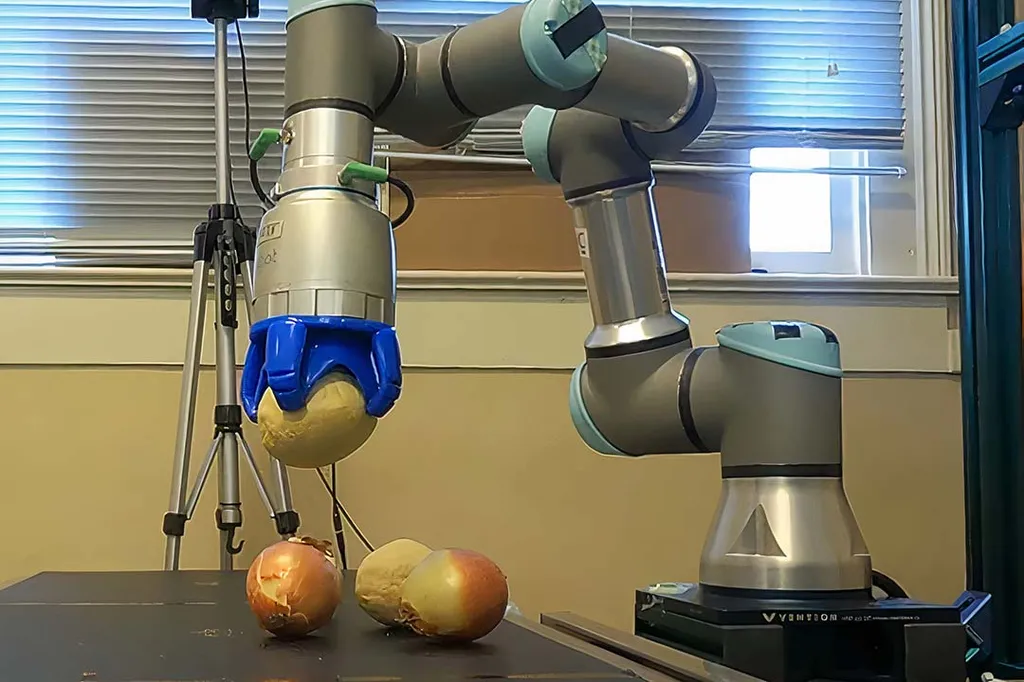
In the rapidly evolving landscape of industrial automation, a groundbreaking study published in ‘ITM Web of Conferences’ is set to revolutionize sorting tasks across various sectors, including agriculture. The research, led by Dong Jiahao from Tianjin Xinhua High School, focuses on the design, application, and future prospects of a UR5 robotic arm sorting system based on the Robot Operating System (ROS). This innovation promises to bring high-precision and flexible control solutions to the forefront of intelligent production lines.
The study delves into the intricate hardware and software design of the system, integrating components such as upper and lower computers, machine vision, and communication protocols. By leveraging ROS-based software tools, the system achieves remarkable sorting accuracy, real-time responsiveness, and environmental adaptability. “The integration of ROS with the UR5 robotic arm has enabled us to achieve unprecedented levels of precision and flexibility in sorting tasks,” says Dong Jiahao, the lead author of the study.
One of the most significant impacts of this research is its potential to transform the agriculture sector. Agricultural product processing often involves complex sorting tasks that require high precision and efficiency. The UR5 robotic arm sorting system can streamline these processes, reducing manual labor and increasing productivity. This technological advancement could lead to significant cost savings and improved product quality, ultimately benefiting both farmers and consumers.
The study also explores the broader applications of the system in industrial manufacturing and environmental protection. In industrial manufacturing, the system can enhance the efficiency of production lines by automating sorting tasks. In environmental protection, it can be used to sort recyclable materials, contributing to sustainability efforts.
Looking ahead, the research discusses future development trends such as multi-robot collaboration, artificial intelligence integration, and adaptive control. These advancements could further enhance the capabilities of the UR5 robotic arm sorting system, making it an indispensable tool in various industries.
The experimental results presented in the study demonstrate the system’s excellent performance, providing a reliable technical reference for the intelligent upgrading of sorting tasks in various fields. As the agriculture sector continues to embrace technological innovations, the UR5 robotic arm sorting system based on ROS could play a pivotal role in shaping the future of agricultural product processing.
In summary, the research led by Dong Jiahao from Tianjin Xinhua High School, published in ‘ITM Web of Conferences’, offers a glimpse into the future of industrial automation. By integrating advanced technologies and leveraging the power of ROS, the UR5 robotic arm sorting system is poised to revolutionize sorting tasks across various sectors, with significant implications for the agriculture industry. As we look ahead, the potential for multi-robot collaboration, artificial intelligence integration, and adaptive control promises to unlock even greater possibilities, driving innovation and efficiency in the years to come.