
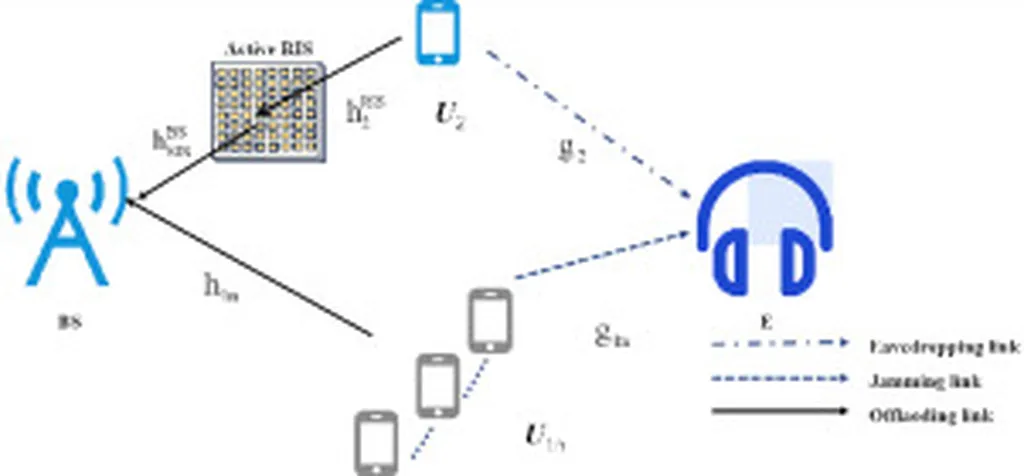
In the rapidly evolving landscape of wireless communication technologies, a groundbreaking study published in the Ain Shams Engineering Journal introduces a novel framework that could revolutionize secure and efficient data transmission, with significant implications for various sectors, including agriculture. The research, led by Changqing Ye from the School of Information Engineering at Southwest University of Science and Technology, focuses on integrating active reconfigurable intelligent surfaces (RIS) with non-orthogonal multiple access (NOMA) to enhance uplink multiuser secure communication networks.
The study addresses critical challenges in modern communication systems, such as eavesdropping threats and the need for ultra-reliable and low-latency communication (URLLC) under finite blocklength (FBL) constraints. By leveraging active RIS and NOMA, the proposed scheme aims to mitigate potential eavesdropping (PEs) while ensuring that legitimate users (LUs) meet stringent URLLC requirements. This is particularly relevant for the agriculture sector, where the increasing adoption of Internet of Things (IoT) devices and precision farming technologies demands robust and secure communication networks.
“Our research demonstrates that active RIS with NOMA can significantly improve security, robustness, and efficiency in communication systems,” said lead author Changqing Ye. “This technology has the potential to transform various industries, including agriculture, by enabling more reliable and secure data transmission for smart farming applications.”
The study formulates a sum rate maximization problem subject to FBL transmission constraints, reliability, latency, and system resource limitations. The researchers developed an alternating optimization (AO) algorithm to jointly optimize LU power allocation, base station (BS) beamforming, and active RIS beamforming. Simulations confirmed that the proposed scheme enhances security and robustness while better meeting URLLC requirements.
The commercial impacts of this research for the agriculture sector are substantial. As farms become increasingly connected through IoT devices, the need for secure and reliable communication networks becomes paramount. The integration of active RIS and NOMA can facilitate real-time monitoring and control of agricultural operations, leading to improved efficiency, productivity, and sustainability. For instance, smart sensors and drones equipped with this technology can provide precise data on soil conditions, crop health, and weather patterns, enabling farmers to make informed decisions and optimize resource usage.
Moreover, the enhanced security features of this communication framework can protect sensitive agricultural data from cyber threats, ensuring the integrity and confidentiality of information. This is particularly crucial for large-scale farming operations that rely on data-driven decision-making processes.
The research also highlights the potential for future developments in the field of wireless communication. As the demand for high-speed, low-latency, and secure networks continues to grow, the integration of active RIS and NOMA offers a promising solution to meet these evolving needs. The study’s findings pave the way for further exploration and innovation in the realm of secure and efficient communication technologies.
In conclusion, the research led by Changqing Ye represents a significant advancement in the field of wireless communication, with far-reaching implications for various industries, including agriculture. By addressing critical challenges in secure and reliable data transmission, this study opens up new possibilities for the future of smart farming and precision agriculture. As the agriculture sector continues to embrace digital transformation, the integration of active RIS and NOMA technologies can play a pivotal role in shaping the future of sustainable and efficient farming practices.