
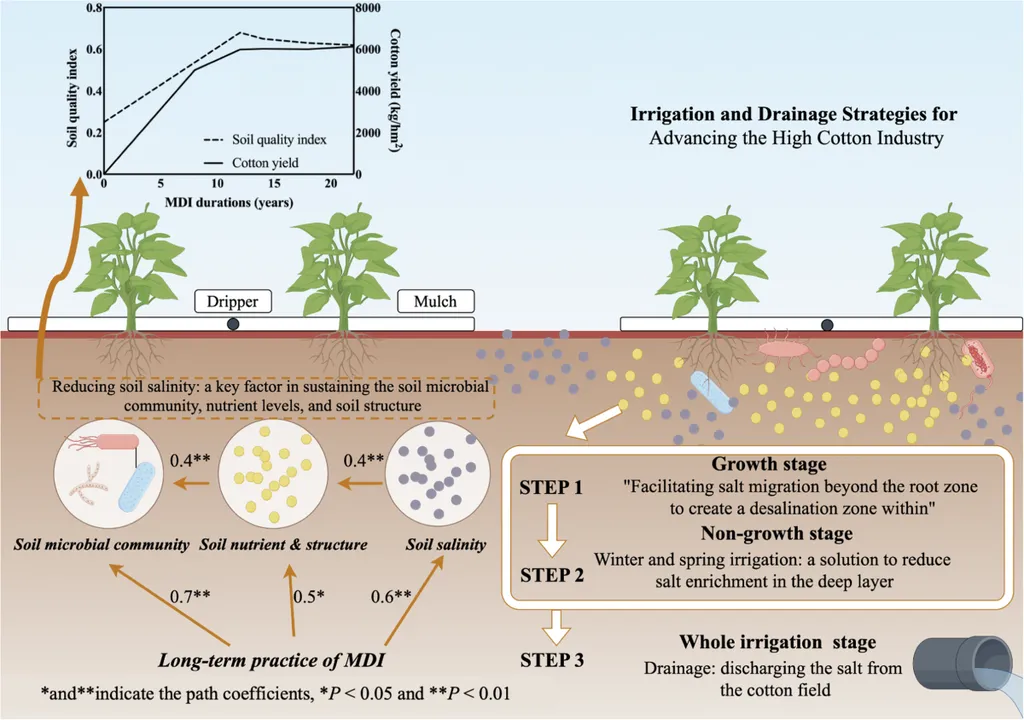
In the arid landscapes of China’s Kaidu River Irrigation District, farmers face a formidable challenge: soil salinization. This persistent issue threatens crop productivity and water efficiency, but a groundbreaking study published in *Agricultural Water Management* offers a promising solution. Researchers, led by Yi Liu from the College of Agricultural Science and Engineering at Hohai University, have developed a synergistic framework that combines drip irrigation with subsurface drainage to combat salinization and boost crop yields.
The study, which leverages advanced modeling techniques, provides a nuanced approach to optimizing irrigation practices. By simulating water-salt dynamics using the SWAT-Salt model, the team assessed 252 scenarios, considering factors such as drip irrigation intervals, winter leaching depths, and subsurface drainage parameters. The results are striking. “We found that optimizing drip irrigation intervals—ranging from 5 to 14 days—significantly improved water productivity and reduced soil salinity,” Liu explains. “When combined with tailored drainage systems, we saw substantial increases in crop yields and economic benefits.”
The research highlights the importance of precision agriculture. For instance, optimal drip irrigation frequencies varied spatially, with wheat benefiting from 9-day intervals upstream and shorter intervals downstream. Maize, tomato, and pepper crops also showed marked improvements when irrigation schedules were tailored to local conditions. “This spatial variability underscores the need for site-specific management strategies,” Liu notes. “One size does not fit all in arid regions.”
The economic implications of this research are profound. By integrating optimized drip irrigation with subsurface drainage, farmers can expect yield increases of up to 16.8% for maize and 14.5% for pepper. Additionally, water productivity improved by 4.0% to 11.7%, and soil salinity decreased by 13.3% to 19.3%. These gains translate into tangible economic benefits, with potential increases of 1,530 to 6,450 yuan per hectare.
The study’s findings have far-reaching implications for the agriculture sector, particularly in arid and saline regions. By adopting this synergistic approach, farmers can achieve a delicate balance between water conservation, salinization mitigation, and productivity gains. “This framework provides actionable strategies for optimizing drip irrigation management,” Liu says. “It’s a step towards sustainable agriculture in challenging environments.”
As the global demand for food continues to rise, innovative solutions like this are crucial. The research not only offers immediate benefits but also paves the way for future developments in precision agriculture. By integrating advanced modeling techniques with practical field applications, the study sets a new standard for sustainable water management in agriculture. For farmers in arid regions, this could be a game-changer, offering a path to higher yields, improved water efficiency, and greater economic stability.