
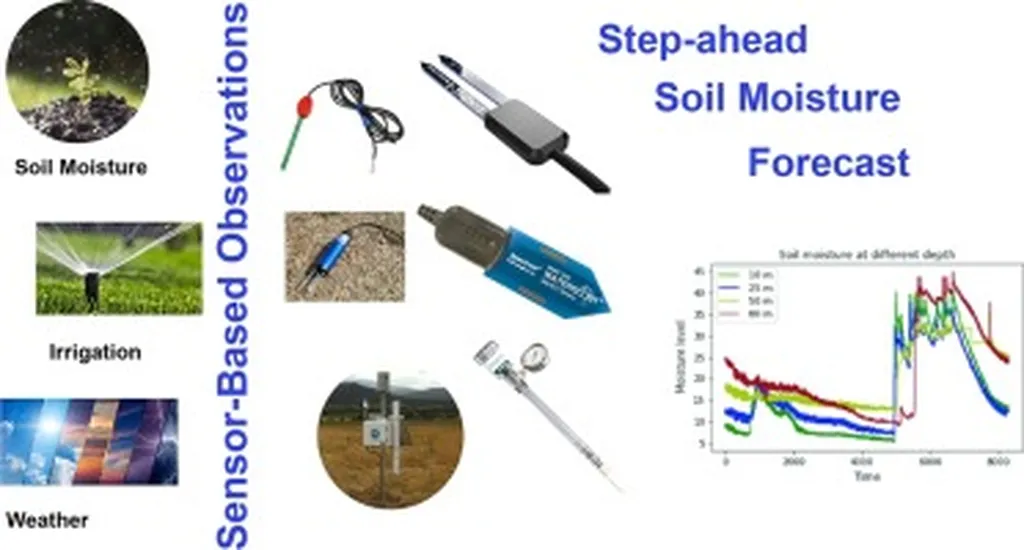
In the quest for precision agriculture, accurate soil moisture monitoring has long been a critical yet challenging endeavor. High costs and complex calibration processes of existing soil moisture sensors have often posed barriers to widespread adoption. However, a recent study published in the *Journal of Agriculture and Food Research* offers a promising solution: a novel chip-based radio frequency (RF) sensor that operates as a fully passive system, coupled with advanced machine learning (ML) and deep learning (DL) calibration models.
The research, led by Jannatul Ferdaous Progga from the Department of Agricultural and Biosystems Engineering at North Dakota State University, introduces a cost-effective and scalable approach to soil moisture estimation. The study evaluates six ML and DL models to transform complex RF signals into reliable volumetric moisture content (VMC) data. Among the models, the Convolutional Neural Network (CNN) demonstrated the best overall performance, with an R2 of 0.78 and an RMSE of 1.92 % VMC, followed closely by the Dense Neural Network (DNN) with an R2 of 0.76 and an RMSE of 2.02 % VMC.
“This research establishes a strong proof of concept for integrating low-cost, chip-based RF sensing with data-driven modeling,” Progga explained. “The high accuracy and stability of the CNN and DNN models confirm their effectiveness in capturing the nonlinear relationships between RF signals and diverse soil properties.”
The study’s findings have significant implications for the agriculture sector. By providing a highly accurate, scalable, and generalized solution for real-time soil moisture estimation, this technology can enhance precision agriculture practices, optimize irrigation scheduling, and contribute to sustainable water resource management. The identification of bulk density and the raw RF signal as the most influential predictors further underscores the robustness of the proposed approach.
As the agriculture industry continues to embrace digital transformation, the integration of advanced sensing technologies and data-driven modeling is poised to revolutionize farming practices. This research not only addresses the limitations of current soil moisture sensors but also paves the way for future developments in smart agriculture. By leveraging the power of ML and DL, farmers and agronomists can make more informed decisions, ultimately leading to improved crop yields and resource efficiency.
The study’s success in diverse soil textures and physicochemical properties highlights its potential for widespread application. As Progga noted, “The high stability of the CNN and DNN models, confirmed through 5-fold cross-validation, ensures their reliability across different soil types and conditions.”
In conclusion, this research represents a significant step forward in the field of precision agriculture. By combining innovative sensing technology with advanced data analytics, it offers a practical and effective solution for real-time soil moisture monitoring. As the agriculture sector continues to evolve, the integration of such technologies will be crucial in meeting the growing demands for sustainable and efficient farming practices.