
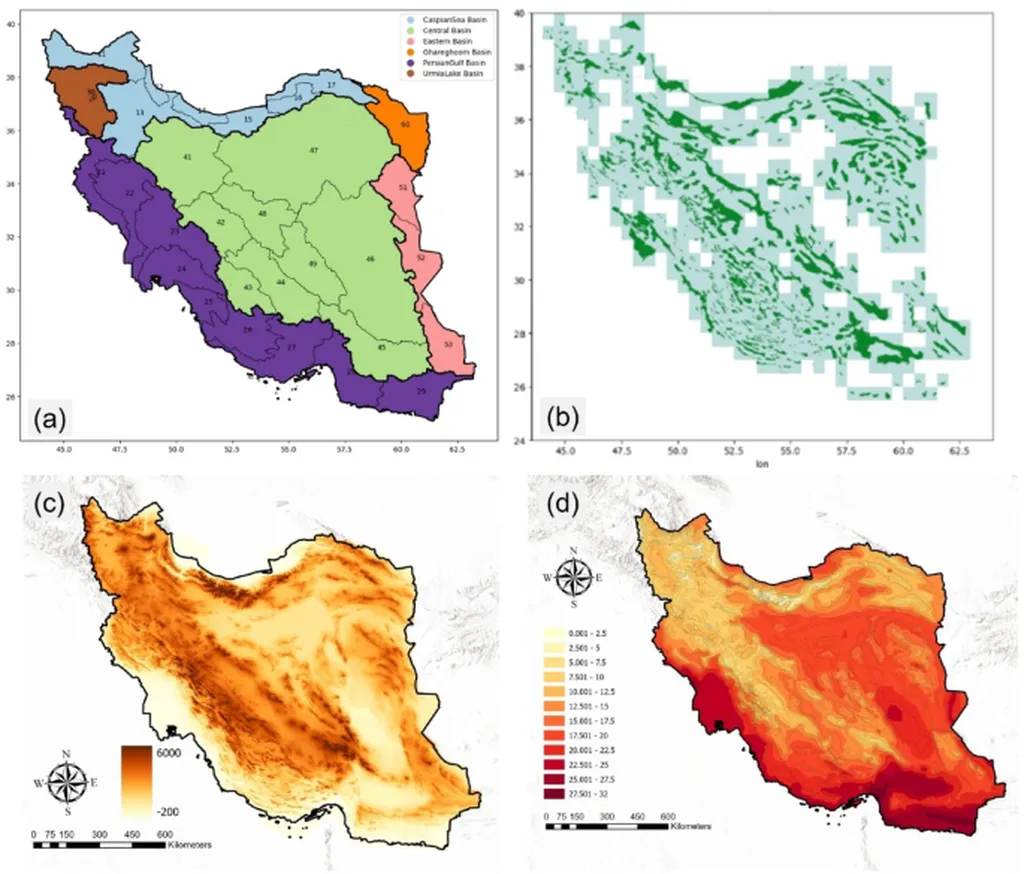
In the heart of Iran’s Alborz Plain, a critical resource is under scrutiny: groundwater. A recent study published in the *Alexandria Engineering Journal* has shed light on the quantity and quality of groundwater in this region, offering valuable insights for both drinking and agricultural uses. Led by Mehdi Hedayatpour, a Ph.D. student in the Department of Civil Engineering at Islamic Azad University, South Tehran Branch, the research employs advanced techniques to assess and predict groundwater dynamics, potentially reshaping sustainable water management practices.
The study analyzed data from 19 aquifers over a span of two decades (2002–2023), focusing on key parameters such as potassium (K⁺), sodium (Na⁺), magnesium (Mg²⁺), calcium (Ca²⁺), sulfate (SO₄²⁻), chloride (Cl⁻), bicarbonate (HCO₃⁻), nitrate (NO₃⁻), pH, electrical conductivity (EC), and total dissolved solids (TDS). Using tools like Piper, Scholler, and Wilcox diagrams, prepared with Aq.QA and MATLAB, the researchers identified dominant water facies and evaluated the suitability of groundwater for various uses.
One of the most significant findings is the variation in water quality across the Alborz Plain. “The Water Quality Index (WQI) results indicate that the groundwater quality is ‘very good’ in the northwest and central regions, declining to ‘good’ in the east, and improving again in the southeast,” Hedayatpour explains. This variation is crucial for agricultural practices, as different regions may require tailored water management strategies to optimize crop yields and minimize environmental impact.
The study also highlights the dominance of certain water facies, such as Ca-HCO₃ or Mg-HCO₃ in the northwest, center, and southeast, and Na-HCO₃ in the east. Notably, three aquifers exhibited Na-SO₄, Na-Cl, and Ca-SO₄ facies, indicating varying degrees of salinity and mineral content. These findings are particularly relevant for the agriculture sector, as high salinity can adversely affect soil health and crop productivity.
Hedayatpour’s research also assessed long-term quality trends using the Mann-Kendall test and Sen’s slope, identifying seven stable aquifer groups through Principal Component Analysis (PCA) and K-means clustering. Additionally, Support Vector Regression (SVR) and Random Forest models were employed to accurately predict TDS trends, providing a robust framework for future water quality monitoring and management.
The study’s findings have significant commercial implications for the agriculture sector. By understanding the spatial and temporal variations in groundwater quality, farmers and policymakers can make informed decisions about irrigation practices, crop selection, and water resource allocation. This integrated approach not only supports sustainable agriculture but also ensures the long-term viability of groundwater resources in the region.
As Hedayatpour notes, “This research provides a practical framework for understanding groundwater dynamics and supporting sustainable management at both regional and national levels.” The insights gained from this study could pave the way for similar assessments in other regions, fostering a more comprehensive understanding of groundwater resources and their sustainable use.
In conclusion, the research led by Mehdi Hedayatpour, published in the *Alexandria Engineering Journal*, offers a detailed and nuanced look at groundwater quantity and quality in the Alborz Plain. By leveraging advanced analytical tools and models, the study provides valuable insights for both drinking and agricultural uses, with significant implications for the agriculture sector. As we continue to grapple with the challenges of water scarcity and environmental degradation, such research is invaluable in guiding sustainable water management practices and ensuring the long-term health of our vital water resources.