
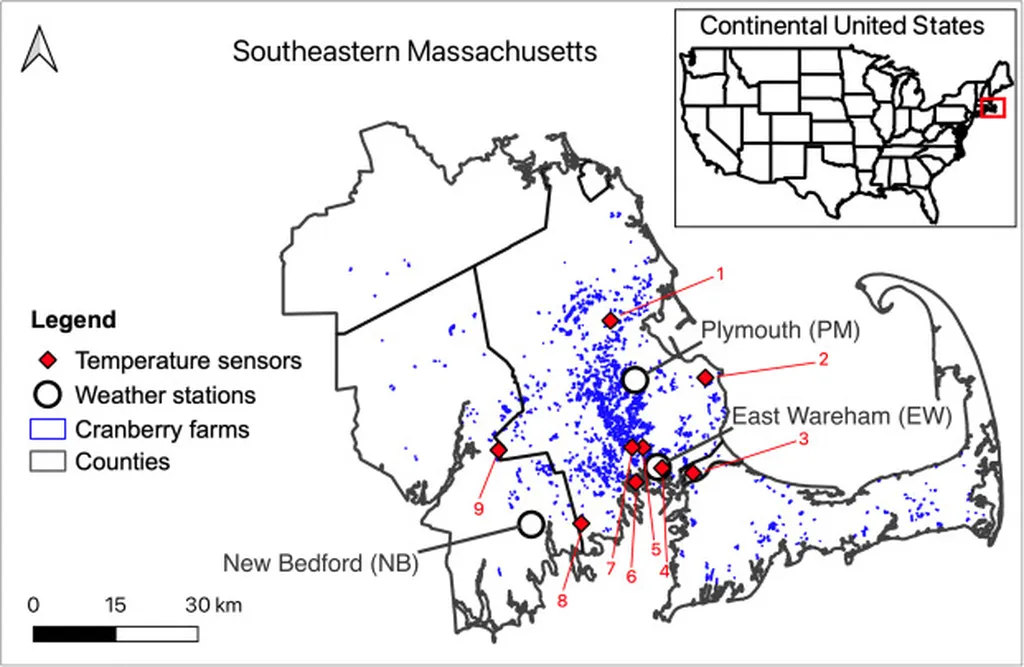
In the rolling landscapes of southeastern Massachusetts, where cranberry bogs stretch out like rubies against the green backdrop, farmers face an annual challenge: the unpredictability of spring frost. These sudden temperature drops can wreak havoc on cranberry crops, leading to significant losses in yield and quality. For decades, growers have relied on the Franklin model, a frost forecasting system developed in the 1940s. But as the climate changes and farming practices evolve, the accuracy of this model has been increasingly called into question. Enter Sandeep Bhatti, a researcher at the University of Massachusetts Cranberry Station, who has been working on a cutting-edge solution to this age-old problem.
Bhatti and his team have harnessed the power of machine learning to develop a more robust and accurate frost forecasting system. By combining mesoscale forecasts from the High-Resolution Rapid Refresh model with meteorological observations from local weather stations, they have created nine random forest models that can predict daily minimum canopy-level air temperature 12 hours in advance. This might sound like a mouthful, but for cranberry growers, it’s a game-changer.
“Our models have reduced the root mean square error by 5.2–6.2 °C compared to the Franklin model,” Bhatti explains. “This might not sound like much, but in the world of frost forecasting, it’s a significant improvement. It’s the difference between knowing you need to protect your crops and scrambling at the last minute.”
The implications for the agriculture sector are substantial. Frost events can lead to losses of water, nutrients, and crop yields, all of which have a direct impact on a farm’s bottom line. By providing more accurate forecasts, Bhatti’s models can help growers make informed decisions about when to deploy frost protection measures, such as sprinkler systems or wind machines. This not only reduces losses but also optimizes the use of resources, making farming more sustainable and efficient.
But the benefits don’t stop at cranberries. The methods described in the study, published in the journal Smart Agricultural Technology, can be adapted for other frost-sensitive crops. Imagine a future where farmers of apples, grapes, and other vulnerable crops have access to similarly accurate forecasting tools. The potential for reducing crop losses and improving farm productivity is immense.
Moreover, the study highlights the importance of integrating real-time sensor networks with advanced modeling techniques. As Bhatti puts it, “The future of agriculture lies in the fusion of data and technology. By leveraging real-time data and machine learning, we can create dynamic, adaptive systems that help farmers navigate the challenges of a changing climate.”
The research conducted by Bhatti and his team at the University of Massachusetts Cranberry Station represents a significant step forward in the field of agricultural technology. By combining the power of machine learning with field observations, they have developed a tool that has the potential to revolutionize frost forecasting and, in turn, improve the resilience and productivity of farms. As we look to the future, the integration of such technologies will be crucial in ensuring the sustainability and success of agriculture in the face of climate change.