
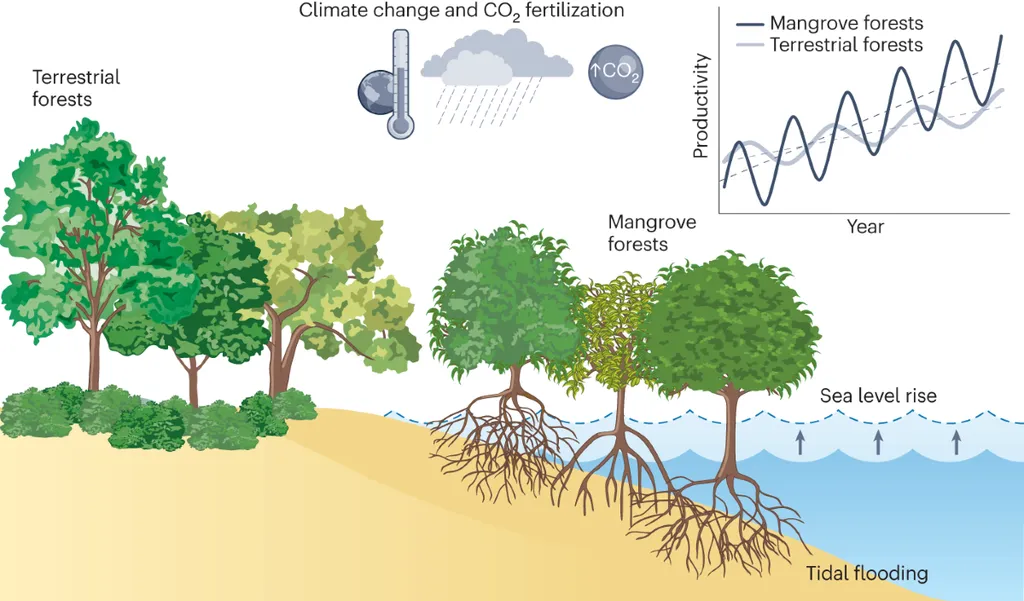
In the fight against climate change, mangrove wetlands are emerging as unsung heroes, acting as substantial carbon sinks. A recent study published in *Climate Smart Agriculture* sheds light on how different vegetation types in these ecosystems regulate the accumulation of various carbon fractions, offering valuable insights for agricultural and environmental strategies.
The research, led by Ziting Chen from the State Key Laboratory for Quality and Safety of Agro-Products at Ningbo University, explores the intricate dynamics of soil organic carbon (SOC) in mangrove wetlands. SOC is a critical component in climate change mitigation, and understanding its composition can help optimize carbon sequestration efforts.
The study examined five different vegetation types along the coastal gradient: bare mudflats, monospecific stands of Spartina alterniflora, mixed stands of S. alterniflora and Kandelia obovata, pure Kandelia obovata stands, and mixed stands of K. obovata and S. alterniflora. The findings revealed that SOC increased from the mudflat to the embankment, with lignin phenols—compounds derived from plant material—being the primary contributor.
“Lignin phenols are a significant part of the carbon pool in these ecosystems,” Chen explained. “Our study shows that areas with high vegetation diversity, particularly mixed stands of K. obovata and S. alterniflora, significantly enhance the relative contributions of lignin phenols and iron-bound organic carbon to SOC.”
The research employed advanced analytical techniques, including random forest analysis and partial least squares structural equation modeling, to identify key influencing factors. Extracellular enzyme activity and iron oxides were pinpointed as critical regulators of SOC and its fractions. Additionally, the study found that soil physicochemical properties directly affect lignin phenols and glomalin-related soil proteins in the topsoil, while vegetation type indirectly influences microbial-derived carbon and iron-bound organic carbon by altering subsoil properties.
These findings have profound implications for the agriculture sector. Understanding how different vegetation types influence carbon sequestration can help farmers and land managers optimize their practices to enhance soil health and mitigate climate change. “This study provides a mechanistic understanding of how vegetation-mediated soil biogeochemistry regulates blue carbon sequestration in mangrove ecosystems,” Chen noted. “It offers a roadmap for developing more effective strategies for carbon management.”
The research also highlights the importance of biodiversity in enhancing carbon sequestration. Mixed stands of different plant species were found to be more effective in accumulating plant-derived carbon and iron-bound organic carbon, while reducing the contributions of microbial-derived carbon. This insight could inform future agricultural practices, encouraging the adoption of diverse cropping systems to improve soil carbon storage.
As the world grapples with the challenges of climate change, studies like this one are crucial. They provide the scientific foundation for developing innovative solutions that can be applied in both natural ecosystems and agricultural landscapes. By leveraging the insights from this research, the agriculture sector can play a pivotal role in the global effort to mitigate climate change and promote sustainable development.
The study, “Vegetation type regulates the accumulation of plant- and microbial-derived carbon in mangrove wetlands,” was published in *Climate Smart Agriculture* and was led by Ziting Chen from the State Key Laboratory for Quality and Safety of Agro-Products at Ningbo University.