
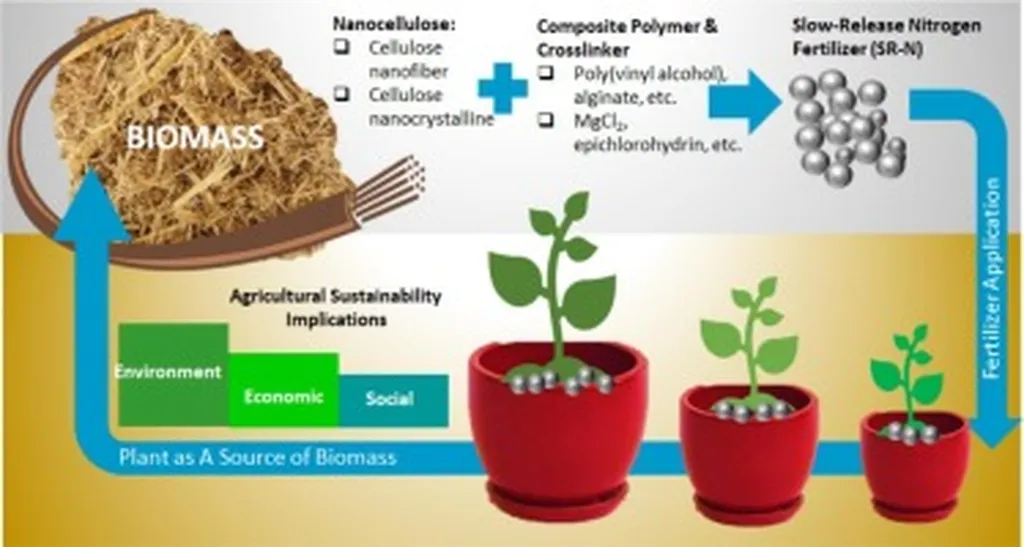
In the quest to enhance agricultural productivity and mitigate environmental impacts, researchers have developed an innovative solution to a persistent problem: nitrogen loss from fertilizers. A study published in *Next Materials* introduces a nanocomposite coating for urea fertilizer that significantly reduces nutrient leaching, offering a promising advancement for sustainable agriculture.
The research, led by Wakshuma Y. Mergo from the Department of Chemistry at Dilla University in Ethiopia and the French National Research Institute for Agriculture, Food and Environment (INRAE), focuses on the development of a nanocellulose-bentonite nanocomposite. This coating is designed to control the release of nitrogen, a critical nutrient for plant growth, particularly in high-rainfall tropical regions where excessive nitrate leaching is a major issue.
The study extracted cellulose from corn husks through alkali treatment and bleaching, followed by the preparation of nanocellulose via sulfuric acid hydrolysis. Bentonite nanoparticles were synthesized through HCl activation and calcination. The nanocomposite was produced at three different ratios, with nanoparticle sizes confirmed via X-ray diffraction analysis. Fourier-transform infrared spectroscopy and scanning electron microscopy further validated the successful formation and uniform dispersion of the nanocomposite.
The coated urea demonstrated a remarkable reduction in nitrogen release. In soil media, it released only 20.47% of ammonium (NH4+) after 11 days, compared to 63.13% from uncoated urea. In water media, the coated urea exhibited a gradual release, reaching a cumulative 64.72% after 7 hours, while uncoated urea released 27.27% within the same timeframe.
“This nanocomposite coating not only enhances nutrient retention but also reduces environmental pollution,” said Mergo. “It’s a step towards more sustainable and efficient agricultural practices.”
The implications for the agriculture sector are substantial. Controlled-release fertilizers can improve crop productivity by ensuring a steady supply of nutrients to plants, reducing the need for frequent applications and minimizing nutrient loss. This innovation could be particularly beneficial in regions with high rainfall, where nutrient leaching is a significant challenge.
Moreover, the use of eco-friendly materials like nanocellulose and bentonite aligns with the growing demand for sustainable agricultural practices. As the global population continues to grow, the need for efficient and environmentally friendly farming methods becomes increasingly urgent.
“This research opens up new possibilities for the development of advanced fertilizers that can meet the demands of modern agriculture while minimizing environmental impact,” Mergo added.
The study suggests that further field trials in acidic soils are necessary to validate the agronomic performance and plant uptake efficiency of the nanocomposite-coated urea. If successful, this innovation could revolutionize the fertilizer industry, offering a more sustainable and effective solution for nutrient management in agriculture.
As the world grapples with the challenges of climate change and food security, advancements like this nanocomposite coating represent a beacon of hope. By reducing nitrogen loss and enhancing nutrient retention, this technology has the potential to shape the future of agriculture, making it more productive, sustainable, and resilient.