
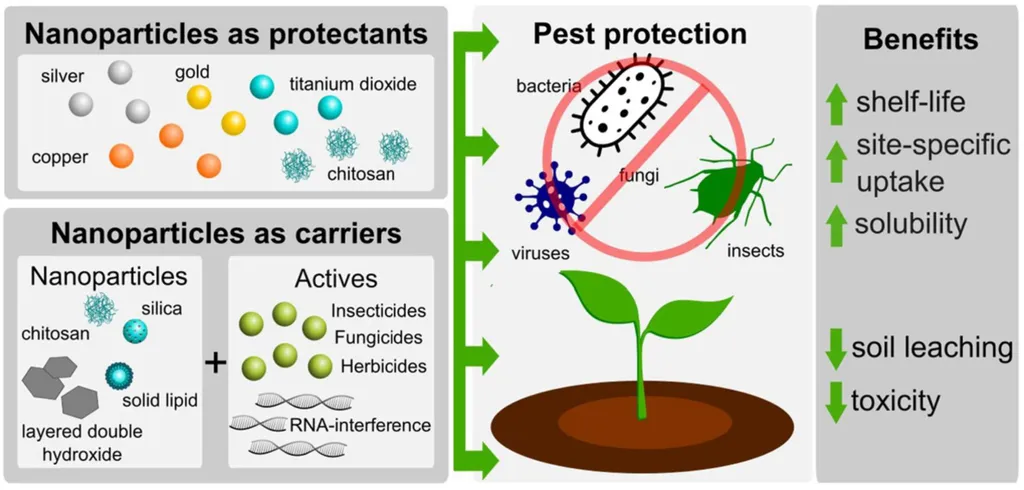
In the relentless battle against fungal pathogens that threaten global agriculture, a beacon of hope emerges from the labs of the Universidad de Castilla-La Mancha. Researchers, led by Maria Paz García-Simarro, have developed a novel solution that could revolutionize crop protection and enhance productivity. Their work, published in *Materials Today Bio*, introduces multifunctional hybrid nanoparticles that not only combat fungal infections but also promote plant growth, offering a sustainable alternative to conventional pesticides.
The study focuses on dendritic mesoporous silica nanoparticles (dMSNs) functionalized with innovative coating agents derived from cinnamaldehyde- (CIN) and β-cyclocitral (βETA) -modified polydopamine (DOPA). These nanoparticles are designed to deliver antifungal agents and support plant development simultaneously, especially under pathogen-induced stress. The dual-release mechanism of these nanoparticles is pH-responsive, releasing up to 94% of geraniol (GER) and 81% of compound βETA at pH 5. This targeted, stimulus-triggered delivery system ensures that the antifungal agents are released precisely where and when they are needed.
The in vitro tests revealed strong antifungal activity against several plant pathogenic fungi, with minimum inhibitory concentrations as low as 0.078 mg/mL. Microscopic analysis showed significant disruption of fungal mycelia after treatment, confirming the effectiveness of the antifungal mechanism. The biosafety of these nanoparticles was established through assays on Drosophila melanogaster, ensuring that they are safe for use in agricultural settings.
In vivo experiments on plants infected with Fusarium oxysporum demonstrated enhanced seed germination and early plant development. Treated plants showed improved root and shoot growth, higher chlorophyll content, and restored levels of key physiological markers like polyphenols and carotenoids. “This study reports two dual-functional nanoparticles that improve the control of fungal pathogens while simultaneously promoting early plant development,” García-Simarro explained. “The findings highlight their potential as sustainable nanobiotechnological tools for protecting crops and enhancing productivity in agricultural systems affected by fungal diseases.”
The commercial implications of this research are profound. With fungal pathogens causing substantial crop loss and food security concerns, the development of sustainable and effective crop protection methods is crucial. These multifunctional nanoparticles offer a promising solution that could significantly reduce the reliance on conventional pesticides, which often have negative environmental impacts. By enhancing crop protection and promoting plant growth, these nanoparticles could lead to increased agricultural productivity and food security.
The research also opens up new avenues for future developments in the field of nanobiotechnology. The dual-functional approach demonstrated in this study could inspire further innovations in sustainable agricultural practices. As García-Simarro and her team continue to explore the potential of these nanoparticles, the agricultural sector can look forward to more advanced and effective solutions for crop protection and growth promotion.
In summary, the development of these multifunctional hybrid nanoparticles represents a significant advancement in the fight against fungal pathogens in agriculture. With their strong antifungal activity, biosafety, and ability to promote plant growth, these nanoparticles offer a sustainable and effective solution for enhancing crop protection and productivity. As the agricultural sector continues to seek innovative and sustainable solutions, this research provides a promising path forward.