
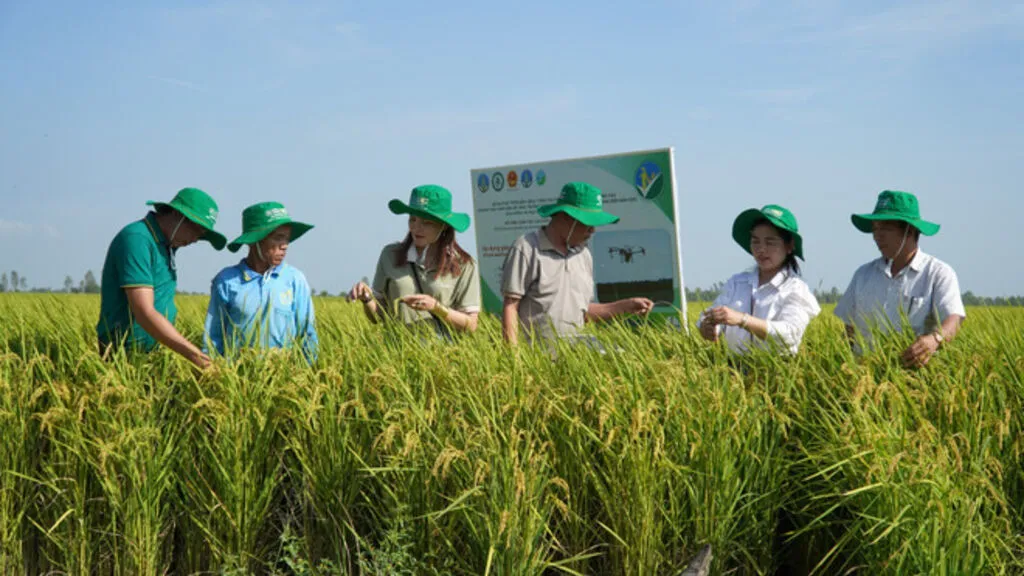
Technology is emerging as a powerful catalyst for green growth in Viet Nam, a country where over 60% of the population resides in rural areas and traditional farming methods still dominate. These methods, characterised by intensive resource use, low efficiency, and vulnerability to climate change, are being challenged by the principles of the circular economy. This economic model emphasises efficient resource use, maximises recycling and reuse, minimises waste, protects the environment, and adds value to agricultural processes.
Science and technology are playing a decisive role in this transformation. They optimise resources, transform by-products into assets, and boost productivity and profits. Across Viet Nam, localities are adopting technologies such as biotechnology, physicochemical methods, artificial intelligence (AI), and the Internet of Things (IoT) to enable clean, closed-loop production. These advancements are not only promoting sustainable agriculture but also enhancing climate resilience.
In the northern midlands, Red River Delta, and Mekong Delta, mechanised straw collection models have been implemented. These models utilise rice straw for mushroom cultivation, livestock feed, and organic fertiliser, raising rice incomes by around 15% compared with traditional practices. Meanwhile, provinces including Phu Tho, Hung Yen, Lao Cai, Tuyen Quang, and Ha Noi are developing circular beef and buffalo farming. Agricultural by-products are used for silage feed, cutting costs and raising efficiency by 10–15%. Livestock waste is biologically processed into organic fertiliser, closing the loop and generating economic benefits while protecting the environment.
Building on these successful local models, many enterprises are proactively engaging in circular agriculture, creating large-scale closed value chains. A notable example is the rice sector circular economy model of ThaiBinh Seed Group Joint Stock Company. According to CEO Tran Manh Bao, the enterprise not only supplies seeds but also plays a central role in the circular value chain. The company has applied digital technology to manage raw material zones, ensure traceability, and govern production chains—optimising costs, reducing emissions, and enhancing transparency.
As a high-tech agricultural enterprise, Hachi Viet Nam High-Tech Joint Stock Company has introduced scientific and technological solutions to drive circular agriculture. These solutions optimise resources such as water, soil, and fertiliser, cutting emissions and pollution, and extending the lifecycle of land and agricultural inputs. Nguyen Thi Mai Huong, Chief Operating Officer of Hachi Viet Nam, explains that the company’s IoT and AI systems precisely monitor humidity, light, temperature, and nutrients, ensuring crops receive only the necessary water and fertiliser. This minimises waste, reduces costs, conserves resources, and lowers greenhouse gas emissions—paving the way for modern, transparent, and sustainable agriculture.
Hachi’s traceability and produce connection technology has also strengthened agriculture’s integration into the circular economy model. Through QR codes and transparent data systems, consumers can track products from cultivation to distribution, building trust and encouraging sustainable consumption. Farmers, meanwhile, gain valuable data to refine production processes, reduce waste, and improve quality. According to Huong, this direct farmer–enterprise–consumer connection has forged a closed value chain, delivering economic, environmental, and social benefits.
Despite its great potential, circular agriculture still faces significant challenges. Value chain linkages remain weak, with limited investment and technology adoption in production. Many farmers persist with linear production, overusing fertilisers and chemicals for short-term yields, which causes environmental pollution. There is also a shortage of skilled human resources for researching and applying waste and by-product treatment technologies, compounded by insufficient policy support.
Ha Van Thang, Chairman of the Viet Nam Council for Agriculture Business (VCAC), notes that there are currently no specific incentives in this field. SMEs struggle to access capital and technology, hindered by limited awareness and management capacity. Policy frameworks remain incomplete, expert teams for waste treatment technology are lacking, and science–technology applications are constrained by outdated regulations. He emphasises that the circular economy is an inevitable path to boosting competitiveness and creating sustainable added value for Vietnamese agriculture. To achieve this, a coordinated policy ecosystem is required, with close collaboration between the State, enterprises, farmers, scientists, and investors.
Vo Van Quang Quang, Deputy General Director of Bac A Commercial Joint Stock Bank (Bac A Bank)—a bank offering comprehensive financial-credit services with priority for high-tech agriculture—assesses that Viet Nam has major agricultural advantages, with 80% of natural land devoted to farming, abundant resources, and a favourable climate. To advance circular agriculture, experts call for accelerated research, application, and transfer of science and technology—particularly biotechnology and digitalisation. However, current production remains largely small-scale and spontaneous, lacking value chain linkages and technological application. This results in low productivity, inconsistent quality, and resource waste.
To advance circular agriculture, experts call for accelerated research, application, and transfer of science and technology—particularly biotechnology and digitalisation