
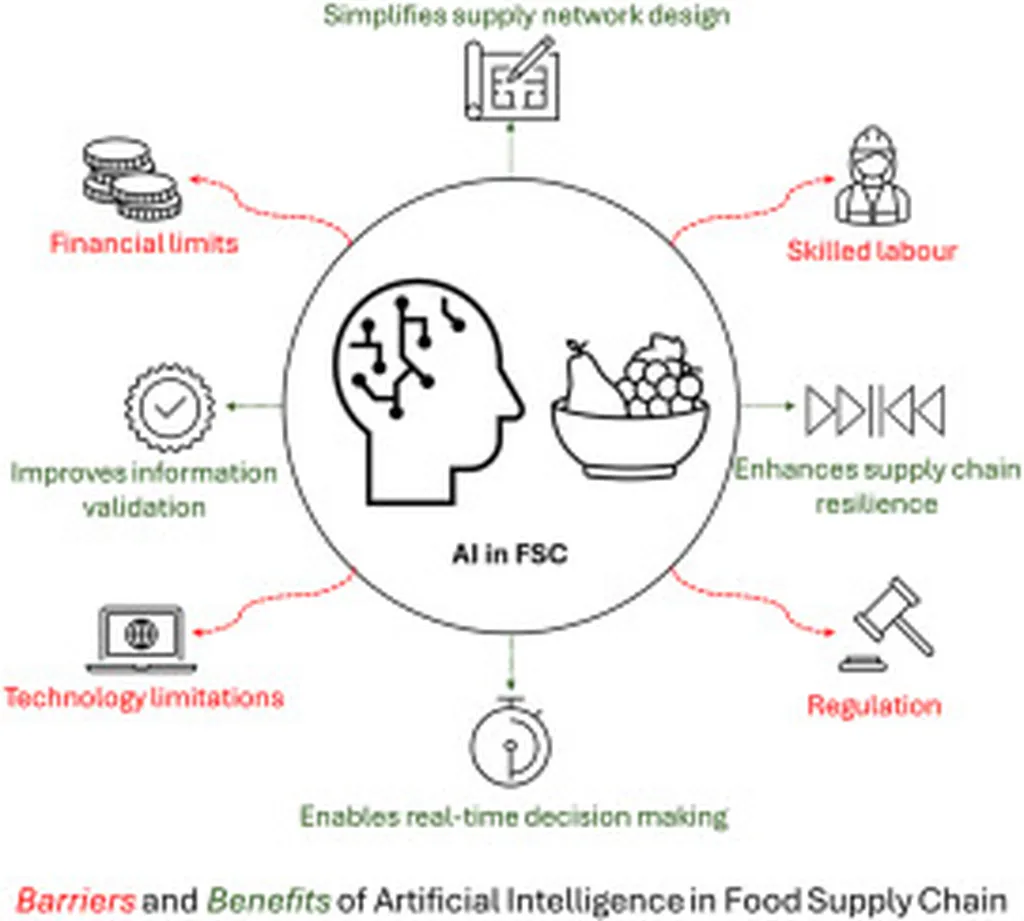
In the ever-evolving landscape of agricultural technology, a groundbreaking study has emerged that promises to revolutionize sustainable supply chain management. Researchers have developed a hybrid framework that combines advanced artificial intelligence techniques to tackle longstanding challenges in the agricultural and food supply chain, including waste reduction, traceability, and profit optimization.
The study, published in *Scientific Reports*, introduces a novel approach that integrates Bidirectional Gated Recurrent Unit (Bi-GRU) networks with a Hybrid Maritime Search and Rescue (HMSR) algorithm. This combination aims to address dynamic disturbances such as weather events and transportation delays, which traditional methods struggle to handle due to their lack of adaptability and scalability.
At the heart of this innovation lies the Bi-GRU model, which utilizes IoT sensors and market trends-based time series data to predict production and storage needs. The HMSR algorithm then steps in to optimize decisions based on various constraints, including production capacity, storage limitations, and market demand. The results are impressive: the framework achieves a 92.4% accuracy in making storage decisions, reduces waste by 34.2%, and maximizes profit margins by 28.7%.
“Our framework outperforms existing models like GRU, LSTM, GA, PSO, and HGSODL-ASCM, demonstrating the potential of hybrid AI-driven approaches in transforming agricultural structures and food supply chains,” said Zhenjie Li, the lead author of the study from Monash University.
The implications for the agriculture sector are profound. By leveraging advanced AI techniques, farmers and agribusinesses can enhance their operational efficiency, reduce waste, and increase profitability. This not only benefits individual enterprises but also contributes to broader sustainability goals by minimizing environmental impact.
The study applied the framework to the Global Food and Agriculture Statistics dataset on Kaggle, along with synthetic disruption scenarios, showcasing its robustness and versatility. The findings highlight the potential for AI-driven solutions to provide adaptable and scalable answers to the complex challenges faced by the agricultural industry.
As the world grapples with the need for more sustainable and efficient agricultural practices, this research offers a glimpse into the future of supply chain management. By integrating cutting-edge technology with practical applications, it paves the way for a more resilient and profitable agricultural sector.
The lead author, Zhenjie Li from Monash University, emphasizes the transformative potential of this hybrid approach, suggesting that it could set a new standard for sustainable supply chain management in agriculture. As the industry continues to evolve, the adoption of such innovative solutions will be crucial in meeting the demands of a growing population while minimizing environmental impact.
In conclusion, this research not only addresses immediate challenges but also lays the groundwork for future developments in the field. By embracing AI-driven technologies, the agricultural sector can achieve greater efficiency, sustainability, and profitability, ultimately benefiting both businesses and consumers alike.