
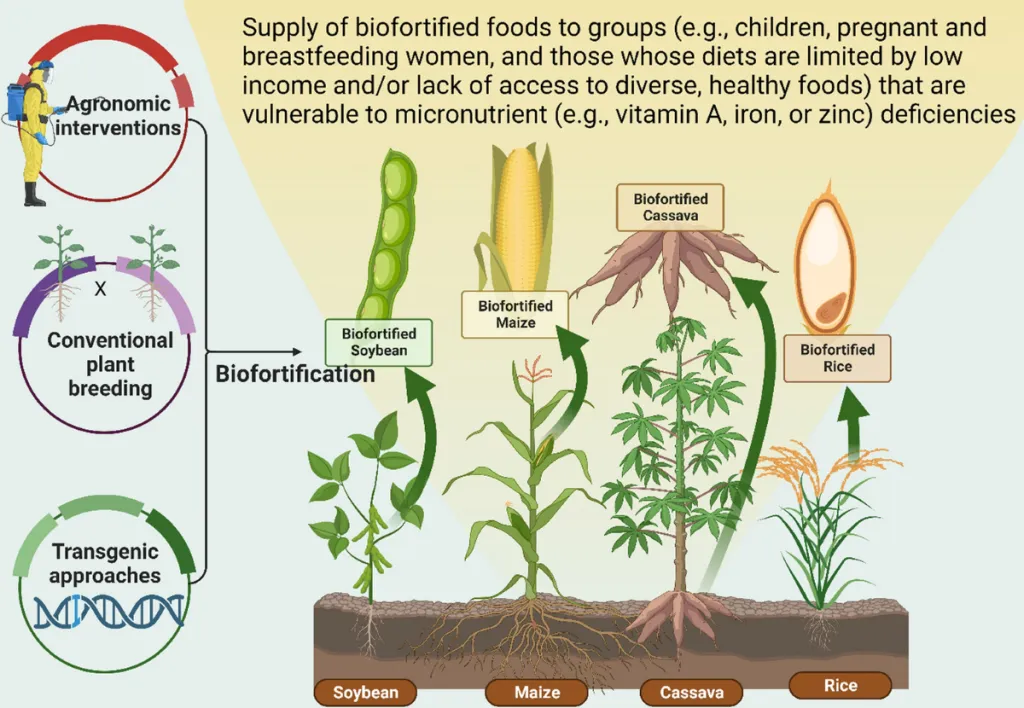
In the face of escalating environmental challenges, a groundbreaking review published in *Discover Agriculture* offers a beacon of hope for the agriculture sector. Led by Shivani Garg of the Institute of Environmental Studies at Kurukshetra University, the research delves into biofortification strategies that not only enhance crop tolerance to metals and metalloids but also boost nutritional quality. This dual approach could revolutionize how we address soil contamination, climate change, and micronutrient malnutrition—issues that collectively affect over 2 billion people worldwide.
The study meticulously examines the intricate mechanisms governing metal and metalloid uptake, translocation, and detoxification in plants. “We’ve identified key transporter systems like ZIP, YSL, COPT, BOR, and SULTR, which play pivotal roles in these processes,” Garg explains. “Understanding these mechanisms allows us to develop strategies that enhance essential nutrient content while conferring cross-tolerance to toxic elements.”
One of the most promising findings revolves around zinc biofortification. By enhancing zinc levels in crops, researchers have observed competitive inhibition against cadmium uptake, thanks to shared transporter pathways. This discovery could significantly reduce the accumulation of toxic metals in food crops, thereby improving food safety and nutritional security.
Iron enhancement is another critical area of focus. The study highlights how increased iron content promotes arsenite exclusion through plaque formation on root surfaces. “This mechanism not only improves the nutritional value of crops but also enhances their resilience to arsenic contamination,” Garg notes.
Silicon and selenium also play crucial roles. Silicon creates physical barriers against metal translocation through phytolith formation and cell wall deposition, while selenium activates antioxidant response element (ARE) pathways, mitigating oxidative stress through enhanced glutathione peroxidase activity. These findings open new avenues for developing crops that are not only more nutritious but also more resilient to environmental stressors.
The review also underscores the potential of genetic engineering, including CRISPR-Cas9-mediated transporter modification and synthetic biology approaches. These technologies are accelerating the development of metal-efficient crop varieties with improved nutritional profiles and stress resilience. “Recent advances in genetic engineering have been game-changers,” Garg says. “They allow us to precisely target and modify the genetic pathways involved in metal uptake and detoxification.”
Emerging technologies such as nanomaterial-based biofortification and rhizosphere microbiome engineering offer additional promising avenues. These innovations could further enhance crop resilience and nutritional security, paving the way for sustainable agricultural intensification.
However, the research also identifies significant knowledge gaps. “We need a deeper understanding of genotype-specific responses and the precise molecular cross-talk between nutrient enrichment and toxic element exclusion,” Garg emphasizes. Integrating omics technologies for predictive biofortification modeling is another critical area for future research.
The implications for the agriculture sector are profound. By enhancing crop resilience and nutritional quality, biofortification strategies could transform global food systems, ensuring food security for millions of people. “This research is not just about improving crop yields; it’s about creating a more sustainable and nutritious food supply for the future,” Garg concludes.
As the agriculture sector grapples with the dual challenges of environmental degradation and nutritional deficiencies, the insights from this review offer a roadmap for developing resilient and nutritious crops. The work of Shivani Garg and her team at the Institute of Environmental Studies at Kurukshetra University represents a significant step forward in the quest for sustainable agriculture and food security.