
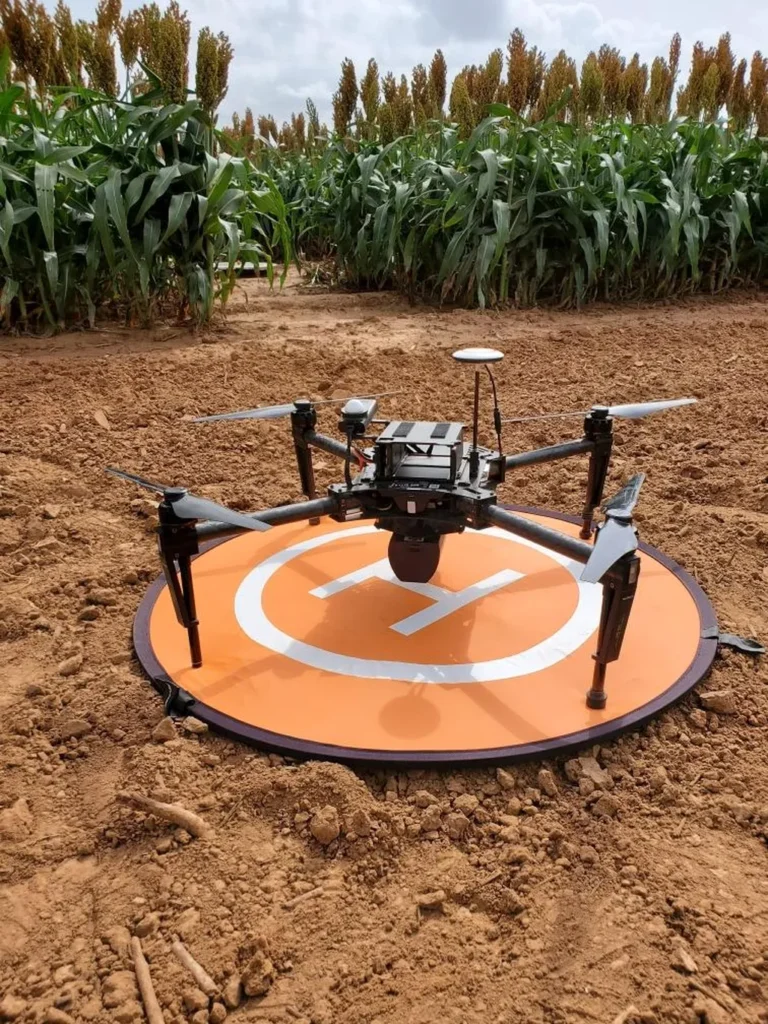
In the ever-evolving landscape of precision agriculture, researchers are continually seeking innovative methods to monitor and analyze crop growth. A recent study published in *Scientific Reports* offers a compelling approach to understanding cotton growth dynamics using unoccupied aerial systems (UAS), commonly known as drones. The research, led by Sindhu Palla from Texas A&M University – Kingsville, demonstrates how high-resolution, multi-temporal data can be harnessed to make informed decisions about crop management and yield prediction.
The study involved collecting red, green, and blue (RGB) images from a cotton field experiment using UAS at multiple points throughout the growing seasons of 2016 and 2021. These images were processed to create digital surface models (DSMs), from which canopy height (CH) measurements were extracted. By fitting several non-linear growth functions to the multi-temporal CH data, the researchers found that the five-parameter logistic function performed best, with an impressive R² value of 0.98 and a remarkably low root mean square error (RMSE) of 6.41.
“Our goal was to develop a robust method for summarizing high-resolution, multi-temporal data to better understand crop growth and development,” said Palla. “By analyzing the first and second-order derivatives of the five-parameter logistic function, we were able to extract several key canopy growth parameters that provided valuable insights into the maturity and yield potential of different cotton genotypes.”
The study revealed that the maximum growth rate derived from the logistic function was strongly correlated with yield, with R² values of 0.46 in 2016 and 0.68 in 2021. Furthermore, the time of onset of the steady phase was used to rate the maturity of the genotypes with 80% accuracy. These findings suggest that the approach could be a game-changer for farmers and agronomists, enabling them to make data-driven decisions about plant growth regulators and other management practices.
The commercial implications of this research are substantial. By leveraging UAS-derived data, farmers can optimize their resources, reduce input costs, and ultimately improve yields. “This technology has the potential to revolutionize the way we monitor and manage crops,” said Palla. “It’s not just about collecting data; it’s about turning that data into actionable insights that can drive better decision-making in the field.”
As the agriculture sector continues to embrace digital transformation, the integration of UAS and advanced data analysis techniques is expected to play a pivotal role in shaping the future of farming. This research paves the way for further exploration of high-throughput phenotyping and its applications in precision agriculture, offering a glimpse into a future where technology and agriculture converge to create more sustainable and efficient farming practices.