
In a significant stride towards combating the agricultural and health threats posed by the fungus Claviceps purpurea, a team of researchers led by Abdullah R. Alanzi from the Center for Research on Medicinal, Aromatic, and Poisonous Plants at King Saud University has identified potential antifungal targets through advanced computational methods. Their findings, published in *Scientific Reports*, offer promising avenues for developing targeted therapies to mitigate the economic and health impacts of C. purpurea infections.
C. purpurea, notorious for producing ergot alkaloids, poses substantial risks to both agriculture and human health. These alkaloids can contaminate cereal crops, leading to severe economic losses and health issues in humans and livestock. The study systematically investigates the pathogenicity of C. purpurea by analyzing the proteomic profiles of five strains, revealing genetic variability in size and GC content. This variability is crucial for understanding the fungus’s adaptability and pathogenicity.
One of the key discoveries in this research is the identification of Alpha-N-acetylglucosaminidase, a hydrolase with significant mass and functional relevance. Despite not matching a UniProt entry, the 3D structure prediction confirmed its integrity, making it a suitable target for further analysis. “The identification of Alpha-N-acetylglucosaminidase as a potential drug target is a significant step forward,” said lead author Abdullah R. Alanzi. “Its functional relevance and structural integrity make it a promising candidate for developing targeted antifungal therapies.”
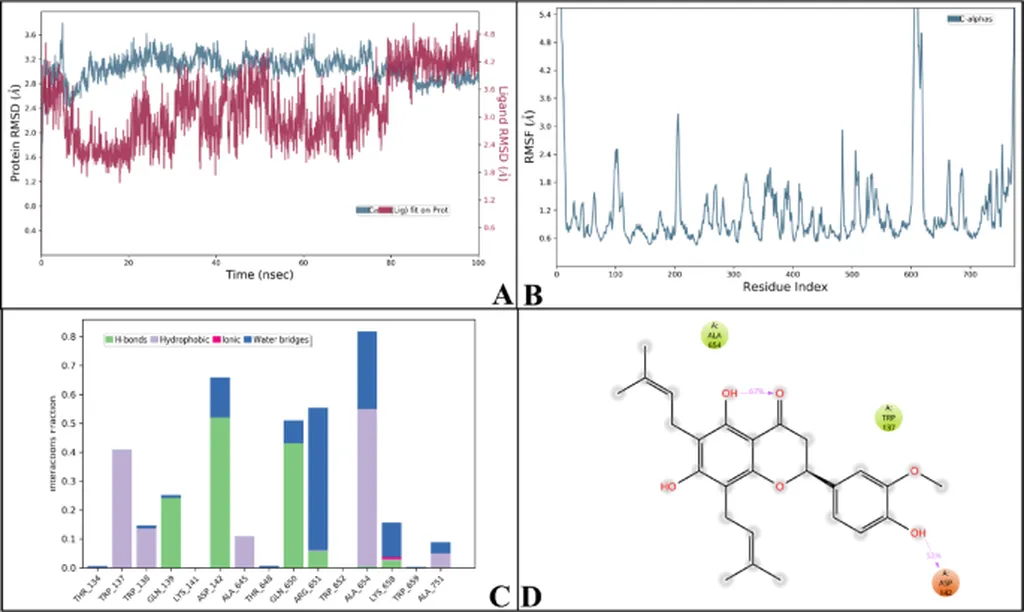
The researchers employed molecular docking to identify ligands with strong binding affinities to Alpha-N-acetylglucosaminidase. Ligands CID:51,535,944 and CID:145,242,255 showed strong binding affinities, highlighting interactions with key residues like TRP138 and ARG651. These interactions were validated through molecular dynamics (MD) simulation analyses, which demonstrated consistency with greater RMSD, RMSF, and PL contacts.
The implications of this research are far-reaching for the agriculture sector. By understanding the genetic diversity and cellular mechanisms of C. purpurea, researchers can develop more effective strategies to combat its pathogenicity. “This research enhances our understanding of C. purpurea and offers insights into its genetic diversity and cellular mechanisms,” Alanzi explained. “It paves the way for innovative interventions in sustainable agriculture.”
The study’s findings contribute to the development of targeted therapies that can mitigate the economic and health impacts of C. purpurea infections. By identifying potential drug targets and validating their interactions through advanced computational methods, the research provides a foundation for future developments in antifungal treatments. This could lead to more effective and sustainable agricultural practices, reducing the economic burden on farmers and ensuring food security.
As the agriculture sector continues to face challenges from fungal pathogens, the insights gained from this research are invaluable. The identification of Alpha-N-acetylglucosaminidase as a potential drug target and the validation of its interactions with specific ligands offer a glimpse into the future of antifungal therapies. With further research and development, these findings could shape the next generation of targeted treatments, ensuring a more resilient and sustainable agricultural landscape.
In summary, the research published in *Scientific Reports* by Abdullah R. Alanzi and his team represents a significant advancement in the fight against C. purpurea. By leveraging computational methods and advanced analytical techniques, the study provides a deeper understanding of the fungus’s pathogenicity and offers promising avenues for developing targeted therapies. This research not only enhances our knowledge of C. purpurea but also paves the way for innovative interventions in sustainable agriculture, ensuring a more secure and prosperous future for the agriculture sector.