
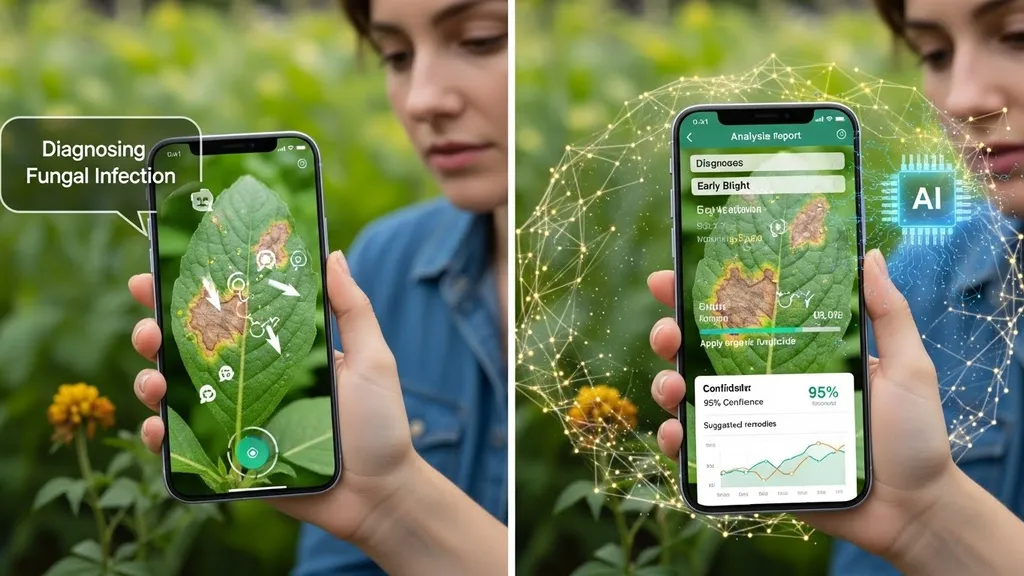
In the heart of precision agriculture, a groundbreaking study has emerged, promising to revolutionize how we monitor plant health. Researchers have successfully developed an artificial neural network (ANN) that can estimate chlorophyll content in plant leaves by analyzing their optical density. This innovation, published in *Инженерные технологии и системы*, could significantly impact the agriculture sector by providing a rapid, non-destructive method for assessing plant health.
Chlorophyll, the pigment responsible for capturing light energy in plants, is crucial for photosynthesis. Monitoring its content helps farmers understand plant-environment interactions and the impact of stress factors, which are essential for yield management. Traditional laboratory methods for analyzing chlorophyll content are time-consuming and destructive, making them unsuitable for rapid field evaluations. This new approach offers a more practical solution using low-cost, portable devices.
The study, led by Sergei A. Rakutko from the Institute for Engineering and Environmental Problems in Agricultural Production (IEEP) – branch of Federal Scientific Agroengineering Center VIM, compiled a dataset from experimental measurements using a densitometer and a chlorophyll meter. Data were collected from lettuce, pepper, tomato, and zucchini leaves of different ages, grown under various light conditions. The ANN was trained in the Google Colab environment and adapted for use in a microcontroller-based photocolorimeter for leaves.
The dataset revealed that the leaf optical density ranged from 0.57 to 2.54 relative units (red), 0.9 to 1.66 relative units (green), and 1.09 to 3.53 relative units (blue). Chlorophyll content variations were found to be between 3.1 and 156.5 relative units. The study compared six ANN architectures, with the “32:32” structure showing the highest accuracy. However, a simplified “4:4” structure was chosen to improve microcontroller efficiency while maintaining performance.
“This approach has significant potential for ecological monitoring and precision agriculture,” Rakutko explained. “The developed model allows for non-destructive and operational monitoring of plant conditions, which is especially important in precision farming systems.”
The trained ANN was implemented on a microcontroller-based photocolorimeter, enabling non-destructive optical density measurements. This innovation could lead to more efficient and accurate monitoring of plant health, ultimately improving crop yields and reducing resource waste.
The study’s results demonstrate the viability of machine learning for improving plant status assessment and developing digital agrotechnology solutions. As precision agriculture continues to evolve, this research could pave the way for more advanced and efficient farming practices.
“This is a significant step forward in the field of precision agriculture,” said a spokesperson for the agricultural technology industry. “The ability to quickly and accurately assess plant health can lead to better decision-making and improved crop management.”
The implications of this research are vast. By providing a rapid, non-destructive method for monitoring chlorophyll content, farmers can make more informed decisions about irrigation, fertilization, and pest control. This can lead to increased crop yields, reduced environmental impact, and improved economic outcomes for farmers.
As the agriculture sector continues to embrace technology, innovations like this ANN-based photocolorimeter could become standard tools in the farmer’s arsenal. The study’s findings not only highlight the potential of machine learning in agriculture but also underscore the importance of ongoing research and development in this field.
In the words of Sergei A. Rakutko, “The future of agriculture lies in the integration of advanced technologies that enable us to monitor and manage crops more effectively. This study is a testament to the power of machine learning in achieving that goal.”