
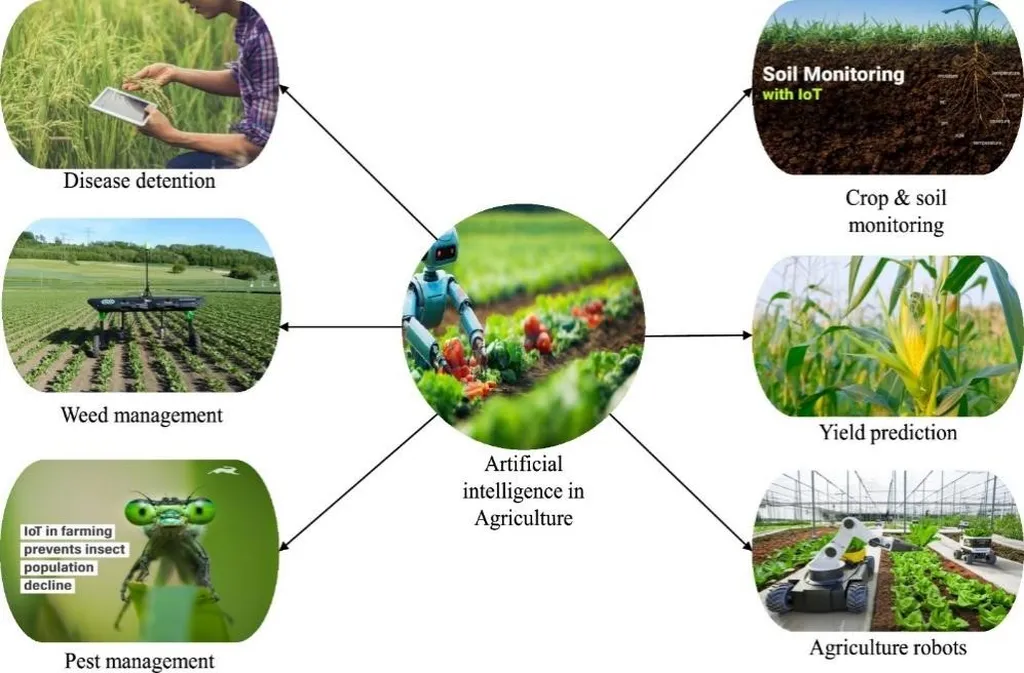
In the heart of Pakistan’s agricultural landscape, a technological revolution is brewing, promising to transform the way farmers tackle one of their most persistent challenges: weed eradication. Researchers from the University of Peshawar have developed a deep learning framework that could redefine precision agriculture, offering a smarter, more sustainable approach to weed management.
The study, published in ‘The Journal of Engineering’, evaluated six convolutional neural network (CNN) architectures to identify weeds in wheat fields accurately. The goal? To enable targeted herbicide application, reducing waste and environmental impact. Among the architectures tested, SqueezeNet emerged as the standout performer, striking an optimal balance between high classification accuracy and low computational complexity.
“SqueezeNet’s efficiency makes it ideal for real-time applications,” said lead author Sarfaraz Khan Khalil from the Department of Electronics at the University of Peshawar. “This is a significant step towards practical, on-site precision farming systems.”
The implications for the agriculture sector are profound. Traditional weed management often involves blanket herbicide application, which is not only costly but also environmentally detrimental. By enabling precise, targeted treatment, this technology could revolutionize farming practices, enhancing sustainability and reducing operational costs.
The research also highlighted that plant maturity significantly improves classification accuracy, a finding that could shape future developments in agricultural technology. As the lead author noted, “Understanding the impact of plant maturity on classification accuracy opens new avenues for research and development in precision agriculture.”
The study’s focus on real-world conditions, using a dataset captured across various growth stages and environmental conditions in Peshawar, ensures its relevance and applicability. The robust evaluation metrics—precision, recall, F1 score, and Area Under the Curve—guarantee the reliability of the findings.
This breakthrough in deep learning for weed eradication is not just an academic exercise; it’s a practical solution with immediate commercial impacts. Farmers could soon have access to tools that make their operations more efficient and sustainable, ultimately benefiting both their bottom line and the environment.
As the agriculture sector continues to embrace smart farming technologies, this research from the University of Peshawar could pave the way for more innovative solutions. The future of farming is here, and it’s smarter than ever.