
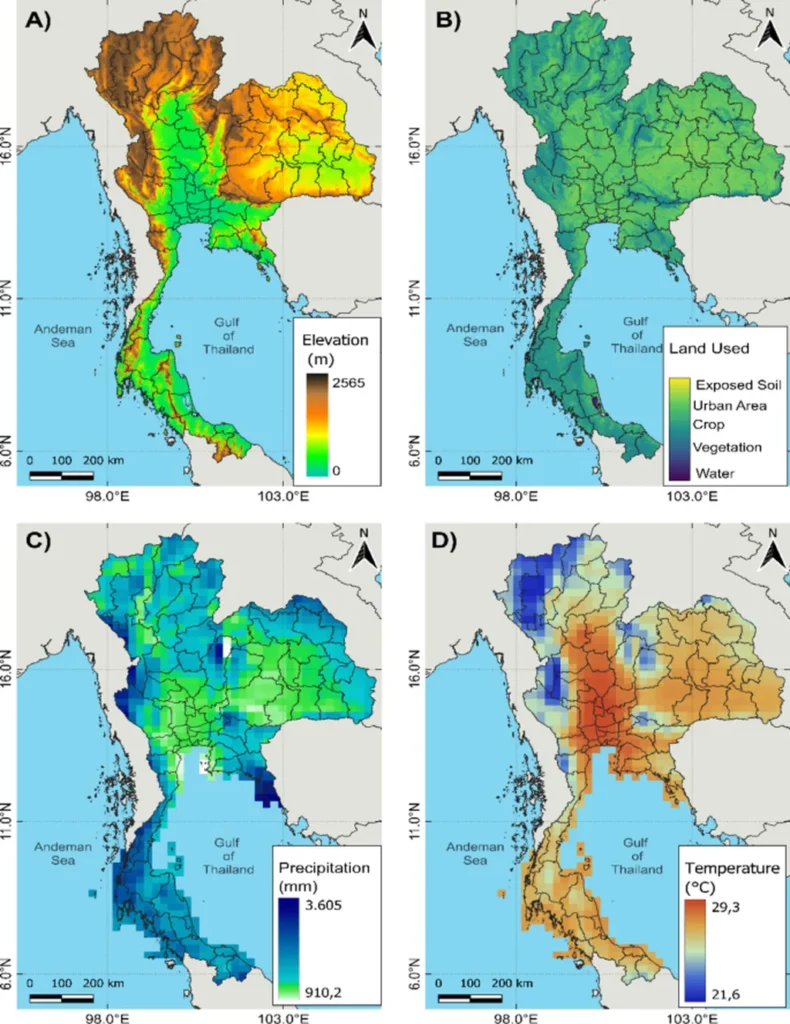
In the heart of Thailand’s Northeast Khong Subwatershed (NKSW), a silent transformation is underway, one that could redefine the region’s agricultural landscape and economic future. A recent study published in *Applied Environmental Research* has shed light on the dynamic changes in land use and land cover (LULC), offering a glimpse into the region’s future and the potential impacts on the agriculture sector.
The research, led by Banchongsak Faksomboon from the Faculty of Science and Technology at Kamphaeng Phet Rajabhat University, employs advanced cellular automata (CA) Markov models integrated with Geographic Information Systems (GIS) techniques. This powerful combination allows for the simulation and prediction of LULC changes, providing a critical tool for sustainable development and land resource management.
Using Landsat data from 2013 to 2023, the study maps out the spatiotemporal distributions of LULC, revealing a region in flux. The model projects that population growth will drive rapid urbanization and rural expansion, significantly altering the land use patterns. By 2103, urban and built-up land is expected to increase from 4.12% to 5.17% of the total land area, a change that could have profound implications for the agriculture sector.
“Our findings indicate a significant shift in land use patterns, which will inevitably impact the agricultural landscape,” Faksomboon explains. “Understanding these changes is crucial for planning and ensuring sustainable development.”
The study underscores the importance of informed decision-making for regional well-being. For the agriculture sector, this means adapting to changing land use patterns, optimizing resource management, and embracing sustainable practices. The projections offer a roadmap for stakeholders to plan ahead, ensuring that agricultural activities remain viable and productive in the face of urban expansion.
The integration of CA Markov models with GIS techniques represents a significant advancement in land use planning. This approach allows for more accurate simulations and predictions, enabling planners and policymakers to make data-driven decisions. As Faksomboon notes, “Developing a future master plan for the watershed should be a top priority. This will guide future planning efforts and ensure sustainable land utilization.”
The study’s findings are a call to action for environmentalists, planners, and decision-makers. By emphasizing sustainable practices and making well-informed decisions, stakeholders can navigate the challenges posed by rapid urbanization and ensure the region’s agricultural sector thrives. The research not only highlights the potential impacts on the agriculture sector but also underscores the need for proactive planning and sustainable development.
As the Northeast Khong Subwatershed stands on the brink of significant change, this study serves as a beacon, guiding the way towards a future where agriculture and urban development coexist harmoniously. The integration of advanced modeling techniques with GIS offers a powerful tool for shaping the region’s future, ensuring that the benefits of development are realized without compromising the environment or the agricultural sector’s viability.