
In the ever-evolving landscape of precision agriculture, researchers have made a significant stride in enhancing the accuracy and interpretability of rice aboveground biomass (AGB) estimation. A recent study published in *Food and Energy Security* integrates the CatBoost ensemble learning algorithm with SHapley Additive exPlanations (SHAP) to offer a more transparent and efficient method for assessing rice AGB. This advancement could revolutionize field management, yield prediction, and decision-making processes in the agriculture sector.
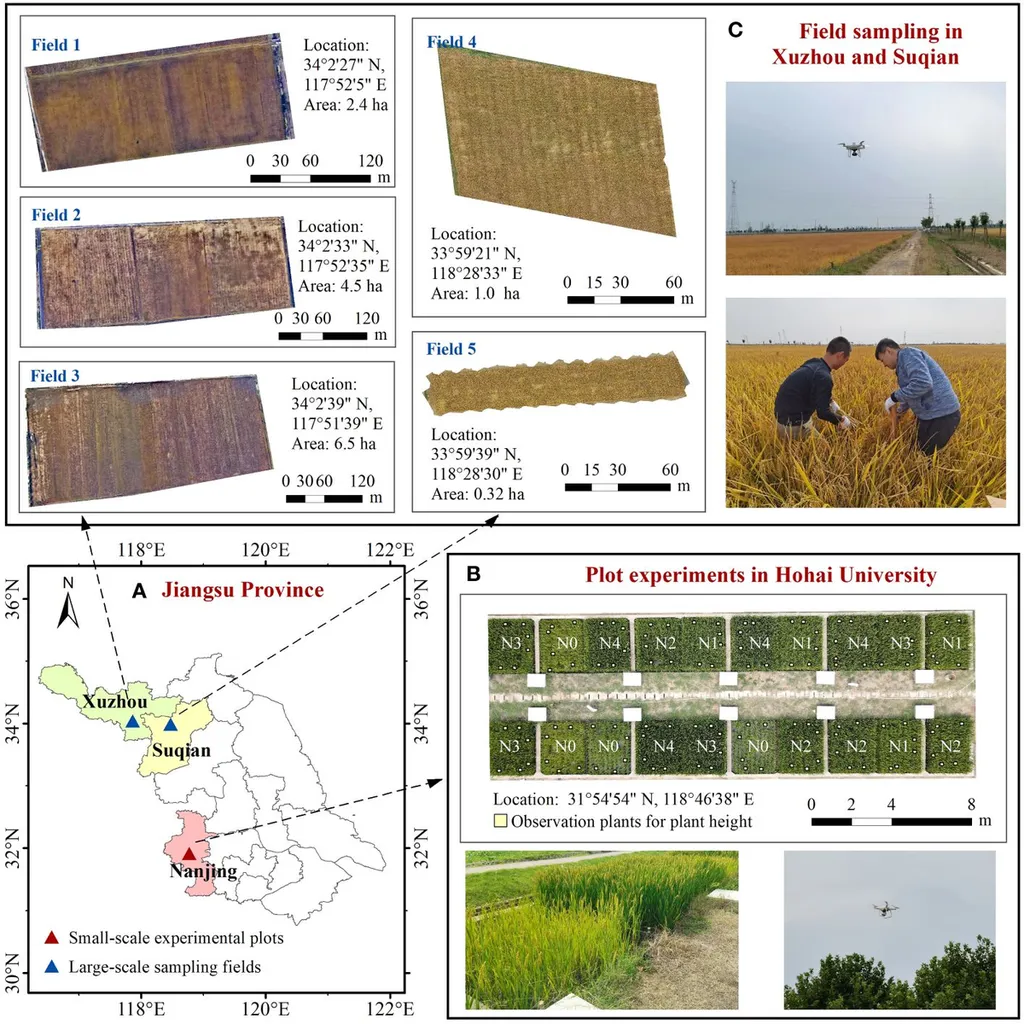
The study, led by Jikai Liu from the College of Resource and Environment at Anhui Science and Technology University in China, utilized an unmanned aerial vehicle (UAV) to capture multispectral images of rice canopies throughout the entire growth cycle under diverse field conditions. The researchers developed a high-precision CatBoost model based on extracted vegetation indices (VIs) and texture features (TFs). This model outperformed both random forest regression (RFR) and LightGBM models, achieving an impressive R² value of 0.96 and a root mean square error (RMSE) of 813.00 kg/ha when trained on 90% of the dataset.
One of the standout features of this research is the use of SHAP analysis to quantify the impact of input features and their interactions on AGB estimation. “SHAP analysis provided us with a clear understanding of how different features contribute to the model’s predictions,” explained Liu. “This interpretability is crucial for farmers and agronomists who need to trust and understand the models they rely on for critical decisions.”
The study revealed that texture features (mean, homogeneity, variance, and correlation) and specific vegetation indices (VARIre, NDRE, and NDVI) were the primary factors influencing AGB estimation. The main and interaction effects of these input features contributed significantly to the model’s performance, highlighting the importance of integrating multiple data sources for accurate predictions.
The commercial implications of this research are substantial. Accurate and interpretable AGB estimation can lead to more informed decision-making, optimizing resource allocation, and improving yield predictions. Farmers can benefit from better field management practices, ultimately enhancing productivity and profitability. As precision agriculture continues to evolve, the integration of advanced machine learning techniques like CatBoost and SHAP can pave the way for more sustainable and efficient farming practices.
This study not only offers a reliable and cost-effective method for AGB estimation but also provides a framework for broader agricultural remote sensing applications. The insights gained from this research could shape future developments in the field, encouraging further exploration of interpretable machine learning models in agriculture. As the agriculture sector continues to embrace technology, the integration of advanced analytics and remote sensing will play a pivotal role in driving innovation and sustainability.
In the words of Liu, “This research is just the beginning. The potential for machine learning and remote sensing in agriculture is vast, and we are excited to see how these technologies will continue to transform the industry.” With such promising advancements, the future of precision agriculture looks brighter than ever.