
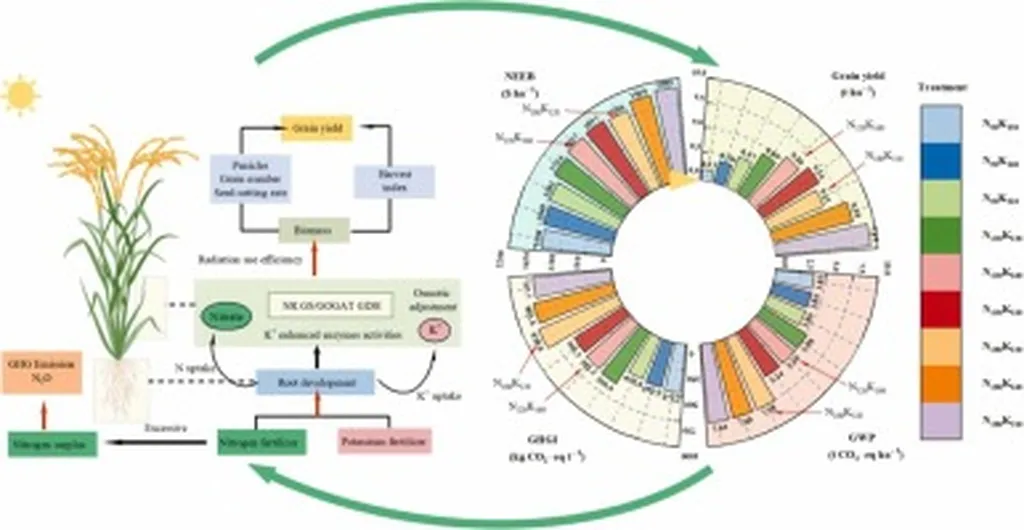
In the heart of southern China, a long-term field experiment is shedding new light on the delicate balance between potassium (K) fertilization and sustainable rice production. The study, led by Ke Wang from the Institute of Resources, Environment and Soil Fertilizer at the Fujian Academy of Agricultural Sciences, has been published in the journal *Food and Energy Security*. It offers valuable insights for farmers and agronomists seeking to optimize rice yields while maintaining soil health.
Potassium is a vital nutrient for crop growth, yet its long-term impacts on rice productivity and soil dynamics have remained underexplored. Wang’s team set out to change that, conducting a 12-year field experiment with single rice cropping. They tested four different potassium fertilization rates: no potassium (CK), 50 kg K per hectare (K1), 75 kg K per hectare (K2), and 100 kg K per hectare (K3).
The results were clear: potassium fertilization significantly boosted rice yields by 8.0% to 13.7% compared to the control group with no potassium application. Notably, the highest yield was achieved with the K3 treatment, although there was no statistical difference among K1, K2, and K3. This suggests that even moderate potassium application can lead to substantial yield improvements.
“Our findings indicate that a potassium fertilizer application rate of 100 kg K per hectare is optimal for obtaining high grain yield and alleviating soil K deficiency under single rice cropping in southern China,” Wang explained. This recommendation could have significant commercial impacts for the agriculture sector, particularly in regions where rice is a staple crop.
The study also revealed that soil K balance was negative under all treatments, highlighting the need for careful management of potassium inputs. However, the soil available K and slowly available K under the K3 treatment were significantly increased by 44.5% and 20.3% relative to the control. Moreover, the slowly available K showed a positive relationship with grain yield, underscoring the importance of maintaining soil K levels for sustainable agriculture.
The implications of this research extend beyond southern China. As global populations grow and agricultural demands increase, understanding the long-term impacts of nutrient management on crop productivity and soil health becomes ever more critical. Wang’s study provides a basis for sustainable agriculture development and reasonable potassium fertilizer management practices, offering a roadmap for farmers and agronomists worldwide.
For the agriculture sector, these findings could translate into improved crop yields, enhanced soil fertility, and more sustainable farming practices. By optimizing potassium inputs, farmers can not only boost their productivity but also contribute to the long-term health of their soils, ensuring the viability of their operations for generations to come.
As the world grapples with the challenges of feeding a growing population, research like Wang’s offers a beacon of hope. By striking the right balance between nutrient inputs and soil health, we can pave the way for a more sustainable and productive future in agriculture.