
In the ongoing battle against invasive insect species, a new weapon has emerged from the intersection of bioacoustics and deep learning. Researchers have developed a novel framework that promises to revolutionize pest management and ecological studies, offering a non-invasive, real-time solution for early identification of harmful insects.
The study, led by Ananjan Maiti from the Department of Computer Science and Engineering at Guru Nanak Institute of Technology in Kolkata, India, presents a sophisticated method that leverages spectral subtraction with wingbeat frequency modulation to identify invasive insects with remarkable accuracy. The research, published in the Journal of Mechanics of Continua and Mathematical Sciences, demonstrates an impressive classification accuracy of 96% to 98% across a dataset of 17 insect species, six of which are invasive.
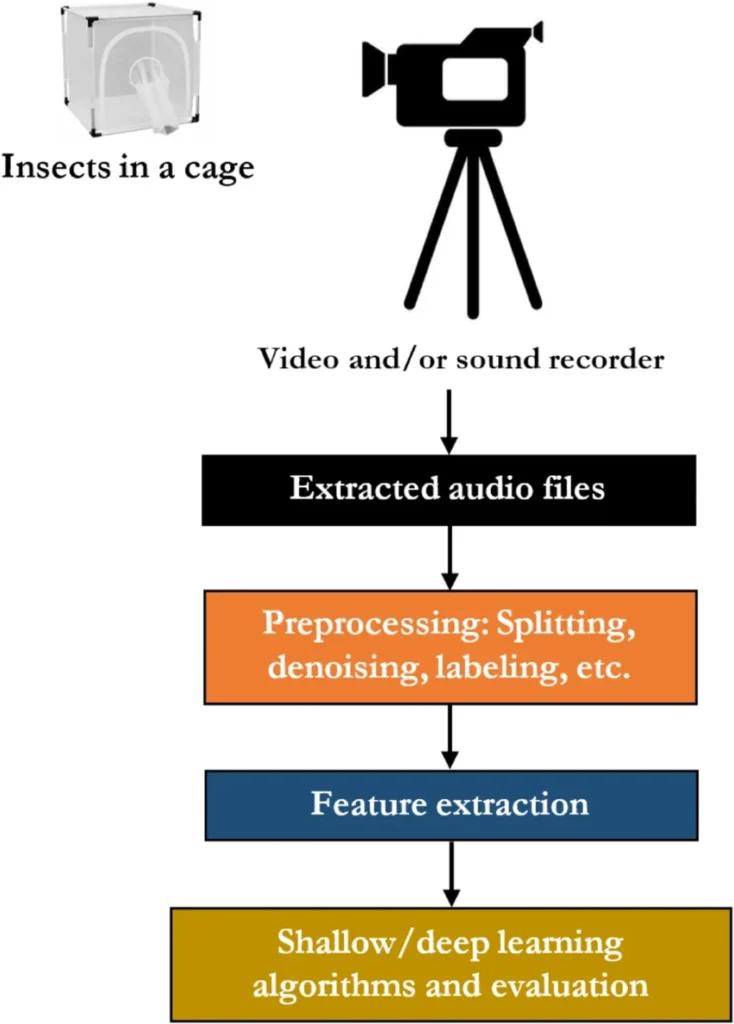
The framework employs a robust pipeline that includes adaptive noise cancellation, spectral subtraction with wingbeat frequency modulation-based features, and a deep learning model. This approach not only enhances the signal-to-noise ratio by 9.64 dB but also provides real-time identification without disrupting the natural environment. “Our method offers a significant advancement over current classification methodologies,” Maiti explains. “The hybrid noise reduction approach and the custom deep learning model, fine-tuned through systematic hyperparameter optimization, set a new standard for accuracy and efficiency.”
The implications for the agriculture sector are profound. Invasive insect species can cause devastating crop losses, leading to significant economic impacts. Traditional methods of pest control often rely on chemical pesticides, which can have harmful environmental side effects. This new technology offers a non-invasive alternative that can detect and identify invasive species early, allowing for more targeted and effective pest management strategies.
Beyond agriculture, the applications of this research extend to defense, ecological studies, and invasive species control. The ability to monitor and identify harmful insects in real-time can provide valuable data for ecological research and help in the development of more effective conservation strategies. “This work provides a solid basis for using acoustic ecology with machine learning for entomological studies and pest control,” Maiti notes.
The study’s methodological enhancements, including the hybrid noise reduction approach and the custom deep learning model, represent a significant leap forward in the field. These advancements not only improve the accuracy of insect classification but also pave the way for future developments in bioacoustic analysis and machine learning applications.
As the agriculture sector continues to face challenges from invasive species, this research offers a promising solution that is both effective and environmentally friendly. The integration of deep learning with bioacoustic analysis opens new avenues for innovation in pest management and ecological monitoring, shaping the future of agricultural technology and environmental conservation.