
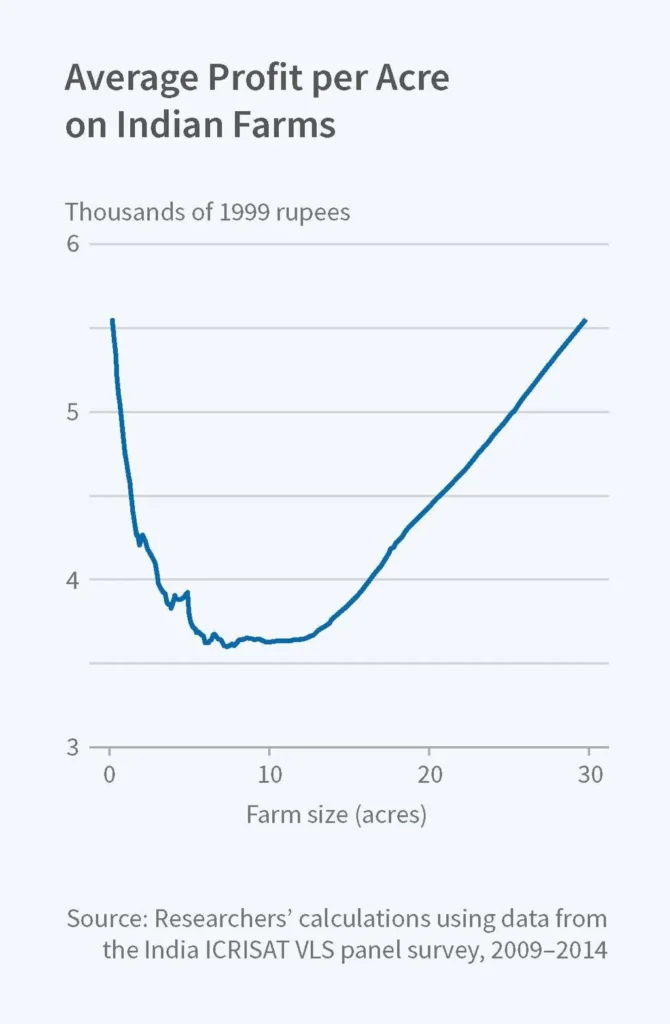
In the vast and varied landscape of Indian agriculture, the size of a farm has long been considered a crucial factor in determining productivity. However, a recent study published in *Circular Agricultural Systems* challenges this notion, revealing that the relationship between farm size and productivity is far more nuanced and regionally specific than previously understood. Led by Subrata Gorain from the Department of Agricultural Economics at Visva-Bharati in West Bengal, the research delves into the dynamics of farm size and productivity in two agriculturally significant states: West Bengal and Punjab.
The study, which analyzed plot-level data from the Cost of Cultivation Scheme (2016–2017), found that West Bengal, where 83% of farmers are categorized as marginal, consistently exhibits an inverse relationship between farm size and productivity in paddy cultivation. This means that smaller farms tend to be more productive. “Smallholders in West Bengal are highly adaptable and efficient in resource management,” Gorain explains. “Their intensive use of labor and ability to tailor practices to local conditions contribute significantly to higher productivity.”
In contrast, Punjab, where only 14% of farmers are marginal, presents a more complex picture. The study found a significant positive relationship between farm size and wheat productivity in Zone I, while Zones II and III showed weaker correlations. “Input optimization is a key determinant of productivity in Punjab,” Gorain notes. “As technological innovations and modern agricultural practices reshape the landscape, the relationship between farm size and productivity is evolving.”
The findings have significant commercial implications for the agriculture sector. In West Bengal, policies that support smallholders—such as access to credit, improved infrastructure, and targeted extension services—could enhance productivity and rural livelihoods. Meanwhile, in Punjab, a balanced approach to mechanization and input management could help optimize productivity across different farm sizes.
The study also highlights the need for region-specific policies. “A one-size-fits-all approach will not work,” Gorain emphasizes. “Understanding the unique characteristics of each region is crucial for sustainable growth in productivity.”
As the agriculture sector continues to evolve, this research underscores the importance of tailored strategies that consider regional dynamics and farm size. By doing so, policymakers and stakeholders can foster sustainable growth and resilience in the face of changing agricultural practices and environmental challenges. The insights from this study, published in *Circular Agricultural Systems* and led by Subrata Gorain from the Department of Agricultural Economics at Visva-Bharati, offer a valuable roadmap for shaping the future of Indian agriculture.