
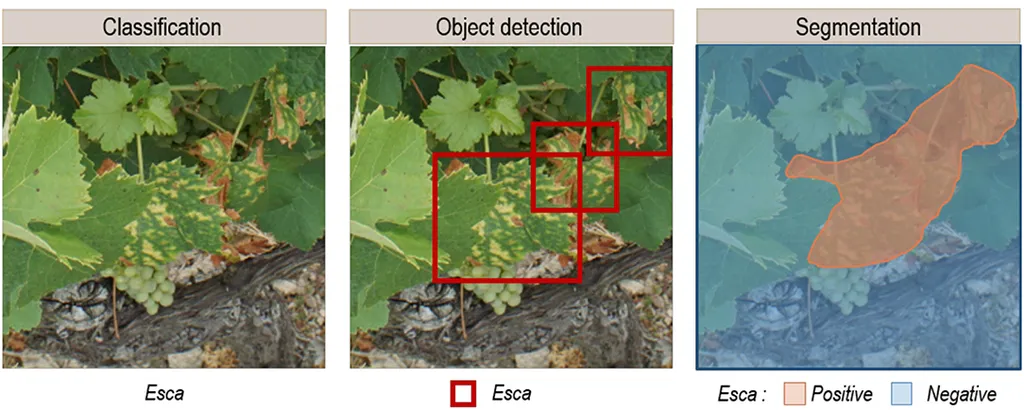
In the ever-evolving landscape of precision agriculture, a groundbreaking study published in *Frontiers in Plant Science* is set to revolutionize how we detect and manage plant diseases. The research, led by Guanqun Sun from the School of Information Engineering at Hangzhou Medical College in China, introduces GARDEN, a novel neural network designed to enhance the accuracy of plant lesion segmentation. This technology could significantly impact the agriculture sector by enabling early disease diagnosis, precise severity assessment, and targeted interventions.
Plant lesion segmentation is a critical task in precision agriculture, aiming to delineate disease regions at the pixel level. However, the variability in lesion sizes—ranging from tiny incipient spots to large coalesced regions—and the ambiguity of low-contrast boundaries that blend into healthy tissue have made this task particularly challenging. GARDEN addresses these issues by unifying multi-scale context modeling with selective long-range boundary refinement.
The GARDEN network integrates a Multi-Scale Context Aggregation (MSCA) module, which harvests contextual cues across diverse receptive fields. This module forms scale-consistent lesion priors, improving sensitivity to tiny lesions. Additionally, the Boundary-aware Selective Scanning (BASS) module, conditioned on a Gradient-Guided Boundary Predictor (GGBP), produces an explicit boundary prior. This prior steers a Mamba-based 2D selective scan, allocating long-range reasoning to boundary-uncertain pixels while relying on local evidence in confident interiors.
“Our approach effectively addresses the key challenges in plant lesion segmentation by coupling scale robustness with boundary precision in a single architecture,” said Guanqun Sun, the lead author of the study. This innovation is poised to deliver accurate and reliable plant lesion segmentation, offering a robust solution for automated disease analysis under challenging real-world conditions.
The implications for the agriculture sector are profound. Accurate and early detection of plant diseases can lead to timely interventions, reducing crop losses and improving yield. Farmers and agronomists can benefit from targeted treatments, minimizing the use of pesticides and other chemicals, which in turn promotes sustainable farming practices.
Moreover, the integration of state-of-the-art techniques like gradient-guided boundary prediction and multi-scale context aggregation sets a new benchmark in the field. As Guanqun Sun noted, “By leveraging advanced neural network architectures, we can achieve unprecedented levels of accuracy and reliability in plant disease diagnosis.”
The study’s findings were validated across two public plant disease datasets, demonstrating state-of-the-art results on both overlap and boundary metrics. The model showed pronounced gains on small lesions and boundary-ambiguous cases, with qualitative results indicating sharper contours and reduced spurious responses to illumination and viewpoint changes compared to existing methods.
This research not only advances the scientific understanding of plant lesion segmentation but also paves the way for future developments in precision agriculture. As the technology continues to evolve, we can expect even more sophisticated tools that will further enhance disease detection and management, ultimately contributing to a more sustainable and productive agricultural sector.
In summary, the introduction of GARDEN represents a significant leap forward in the field of plant lesion segmentation. With its ability to accurately and reliably detect plant diseases, this technology holds immense potential for transforming precision agriculture and supporting the global effort towards sustainable farming.