
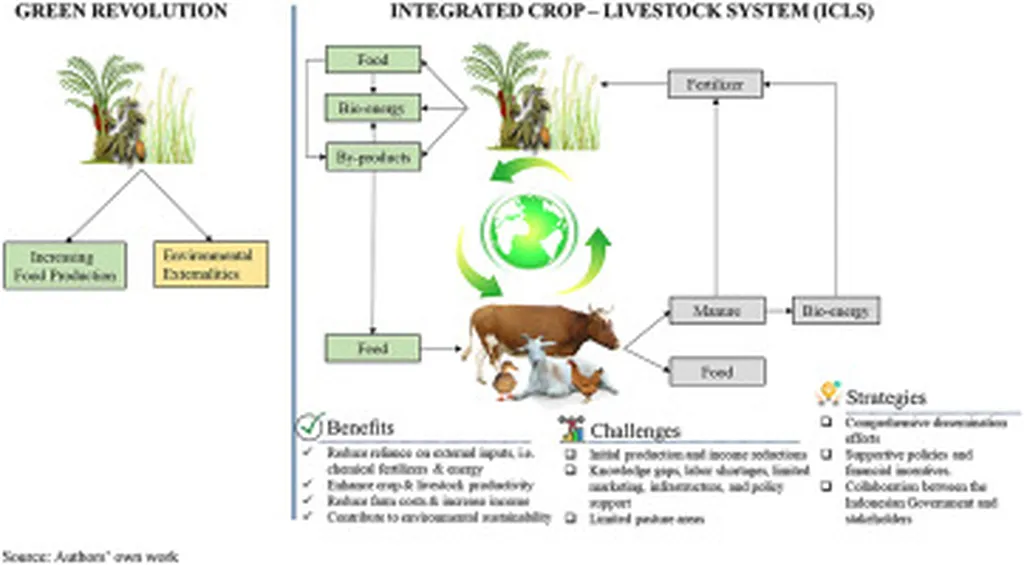
In the lush landscapes of Indonesia, where palm trees sway under the tropical sun, a quiet revolution is taking root. The world’s largest producer of crude palm oil is turning to innovative solutions to address pressing challenges, and a recent study published in *Agricultural Economics (AGRICECON)* is shedding light on a promising approach. Atien Priyanti, a researcher at the Research Center for Behavioral and Circular Economics in Jakarta, has been exploring how the palm oil industry can embrace the circular bioeconomy to tackle cattle feed shortages and boost sustainability.
The palm oil industry, while a powerhouse in Indonesia’s economy, has faced significant criticism for its environmental and social impacts. Enter the circular bioeconomy, a concept that prioritizes sustainable production and consumption by repurposing, recycling, and regenerating resources. Priyanti’s research delves into the integration of palm and cattle farming, a synergy that could redefine resource efficiency and sustainability in agriculture.
Using system dynamics analysis, Priyanti modeled the circular bioeconomy within the palm oil industry, focusing on addressing cattle feed shortages. The results are striking: by utilizing oil palm biomass, the industry could produce a staggering 21,204.52 tonnes of feed annually, generating a revenue of USD 317,020.14. “This isn’t just about addressing feed shortages,” Priyanti explains. “It’s about reducing waste, enhancing farm productivity, and creating a more resilient agricultural system.”
The commercial implications of this research are profound. By integrating palm by-products into cattle feed, farmers can tap into local resources, adding value to what was once considered waste. This not only reduces the need for imported feed but also opens up new revenue streams. “The potential for value addition is enormous,” Priyanti notes. “It’s a win-win situation for both the palm oil and cattle farming industries.”
The study also highlights the importance of understanding the carrying capacity of local resources. By optimizing the use of oil palm biomass, farmers can ensure that they are operating within sustainable limits, preserving the environment for future generations. This approach aligns with the broader goals of the circular bioeconomy, which seeks to create a harmonious balance between economic growth and environmental stewardship.
As the agricultural sector grapples with the challenges of climate change, resource depletion, and economic pressures, Priyanti’s research offers a beacon of hope. The integration of palm and cattle farming is just one example of how the circular bioeconomy can transform the industry. By embracing these innovative practices, farmers can enhance their productivity, reduce their environmental footprint, and contribute to a more sustainable future.
The findings of this study are not just academic exercises; they are practical solutions that can be implemented on the ground. As Priyanti puts it, “The circular bioeconomy is not a distant dream. It’s a reality that we can achieve today, with the right policies, investments, and collaborations.”
In the coming years, we can expect to see more agricultural sectors adopting circular bioeconomy practices. The palm oil industry in Indonesia is leading the way, but the principles can be applied to other crops and regions. As the world seeks sustainable solutions to feed its growing population, the circular bioeconomy offers a promising path forward. With researchers like Atien Priyanti at the helm, the future of agriculture looks brighter and more sustainable than ever.