
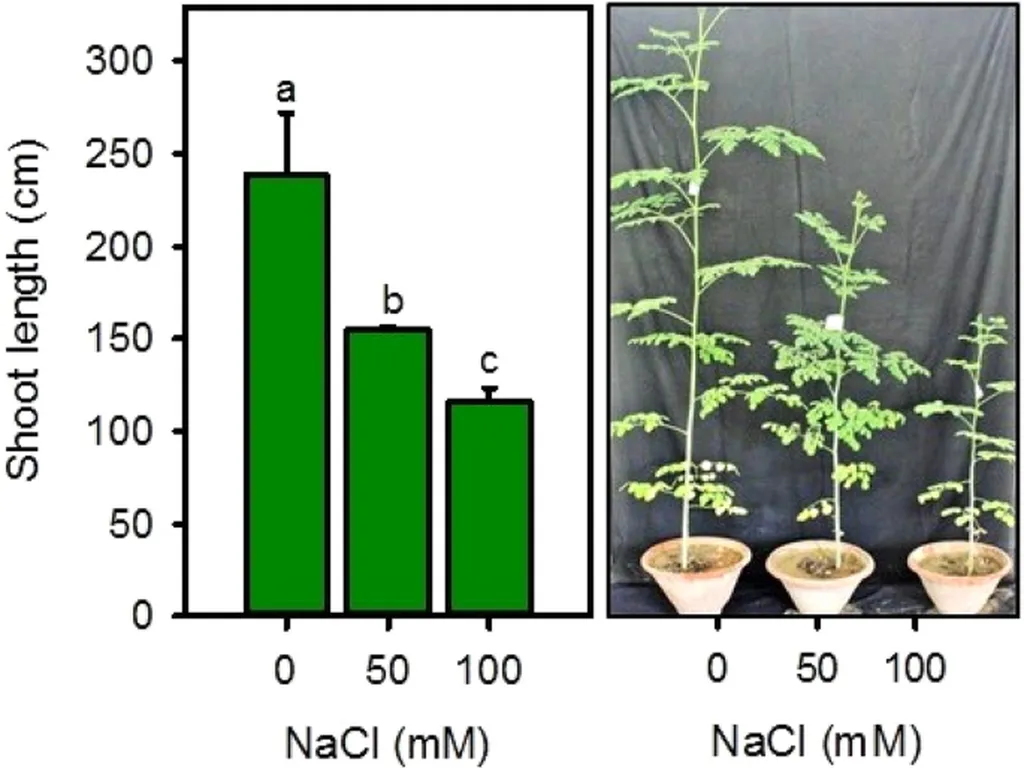
In the arid landscapes where water is scarce and soil salinity poses a constant challenge, farmers are continually seeking resilient crops that can thrive under such harsh conditions. A recent study published in the *Journal of Oasis Agriculture and Sustainable Development* offers promising insights into the adaptability of *Moringa oleifera*, a versatile plant known for its medicinal properties and nutritional value. The research, led by Naceur El Ayeb of the Biolival Laboratory at the Higher Institute of Biotechnology of Monastir, Tunisia, explores how *M. oleifera* responds to hydric and saline stress, potentially unlocking new opportunities for agriculture in desert and saline environments.
The study reveals that *M. oleifera* exhibits remarkable tolerance to salinity levels ranging from 2 to 6 grams per liter. This adaptability is crucial for regions where water resources are limited and often saline. “The species demonstrated a tolerance to a salinity level of 2 to 6 g/L, adapting by intensively branching its roots to enhance nutrient and water absorption,” El Ayeb noted. This root adaptation is a key survival strategy, allowing the plant to access deeper water sources and nutrients, even in arid conditions.
One of the most intriguing findings of the study is the plant’s ability to accumulate proline in response to stress. Proline, an amino acid, plays a protective role in plants under stress conditions, helping to stabilize proteins and cellular structures. The research showed that irrigation with saline water significantly increased proline content in *M. oleifera* leaves compared to plants irrigated with non-salinized water. This biochemical response suggests that the plant has developed sophisticated mechanisms to cope with environmental stressors, making it a strong candidate for cultivation in challenging terrains.
The implications for the agriculture sector are substantial. With the global demand for sustainable and resilient crops on the rise, *M. oleifera* could emerge as a valuable asset for farmers in arid and semi-arid regions. Its ability to thrive in saline soils and under water stress conditions could open up new avenues for agricultural expansion in areas previously deemed unsuitable for farming. Moreover, the plant’s medicinal and nutritional benefits add an economic dimension, as large-scale cultivation could support the production of high-value products for both local and international markets.
The study also highlights the potential for *M. oleifera* to be cultivated in sebkhas—salt flats—and other saline lands, which are typically underutilized due to their inhospitable conditions. By leveraging the plant’s adaptive features, farmers could transform these marginal lands into productive agricultural areas, contributing to food security and economic development in regions facing water scarcity and soil degradation.
As the world grapples with the challenges of climate change and resource depletion, the search for resilient crops becomes increasingly urgent. The findings of this research offer a glimmer of hope, demonstrating that nature has already equipped certain species with the tools to survive in harsh environments. By understanding and harnessing these natural adaptations, we can pave the way for a more sustainable and resilient agricultural future.
The study, led by Naceur El Ayeb of the Biolival Laboratory at the Higher Institute of Biotechnology of Monastir, Tunisia, and published in the *Journal of Oasis Agriculture and Sustainable Development*, provides a compelling case for the potential of *M. oleifera* in transforming agriculture in challenging environments. As researchers continue to explore the plant’s capabilities, the agricultural sector stands to gain valuable insights and opportunities for innovation.