
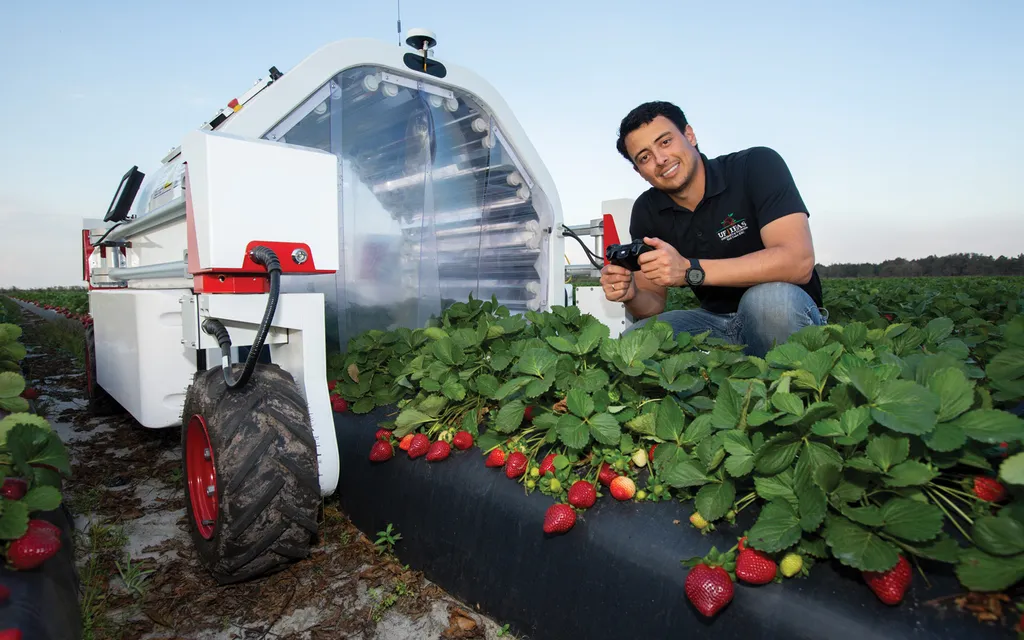
In the ever-evolving landscape of agricultural technology, a groundbreaking development has emerged that promises to revolutionize the way we approach crop phenotyping. Researchers have designed a compact, high-throughput phenotyping platform that integrates multiple sensors, offering a cost-effective and efficient solution for greenhouse strawberry cultivation. This innovation, detailed in a recent study published in *Fruit Research*, addresses the critical need for precise and scalable phenotyping in diverse environments.
The platform, developed by lead author Xi Tan and colleagues at the National Engineering Research Center for Agro-Ecological Big Data Analysis and Application at Anhui University, integrates an RGB-D camera, a multispectral camera, a thermal camera, and a LiDAR sensor. This multi-source sensor data fusion system enables synchronized data acquisition and analysis, a significant advancement given the constraints of load capacity and available space in traditional phenotyping systems.
“Our goal was to create a system that could accurately extract key phenotypic parameters while being portable and adaptable to various environments,” said Xi Tan. The platform has demonstrated remarkable accuracy in extracting parameters such as canopy width and average temperature, with errors maintained below 5%. This level of precision is crucial for optimizing crop management and improving yield.
One of the most notable achievements of this research is the platform’s ability to distinguish between different strawberry varieties with an Adjusted Rand Index of 0.94. This capability underscores the value of detailed phenotyping in variety differentiation, a critical aspect of crop management that can lead to better breeding programs and more tailored agricultural practices.
The commercial implications of this research are substantial. Traditional phenotyping methods often involve bulky and expensive equipment, limiting their scalability and efficiency. The proposed platform, however, is not only more cost-effective but also more efficient and scalable. “This system offers a promising solution for agricultural applications, particularly in greenhouse environments where space and load capacity are limited,” Tan explained.
The integration of multi-source sensors into a single, compact platform represents a significant leap forward in agricultural technology. By providing accurate and consistent data, this system can help farmers and researchers make informed decisions that enhance crop productivity and sustainability. The potential for future developments in this field is vast, with the possibility of extending this technology to other crops and environments.
As the agricultural sector continues to embrace technological advancements, innovations like this phenotyping platform will play a pivotal role in shaping the future of farming. The research published in *Fruit Research* by Xi Tan and colleagues at the National Engineering Research Center for Agro-Ecological Big Data Analysis and Application at Anhui University marks a significant step forward in this journey, offering a glimpse into the potential of advanced phenotyping technologies to transform agriculture.