
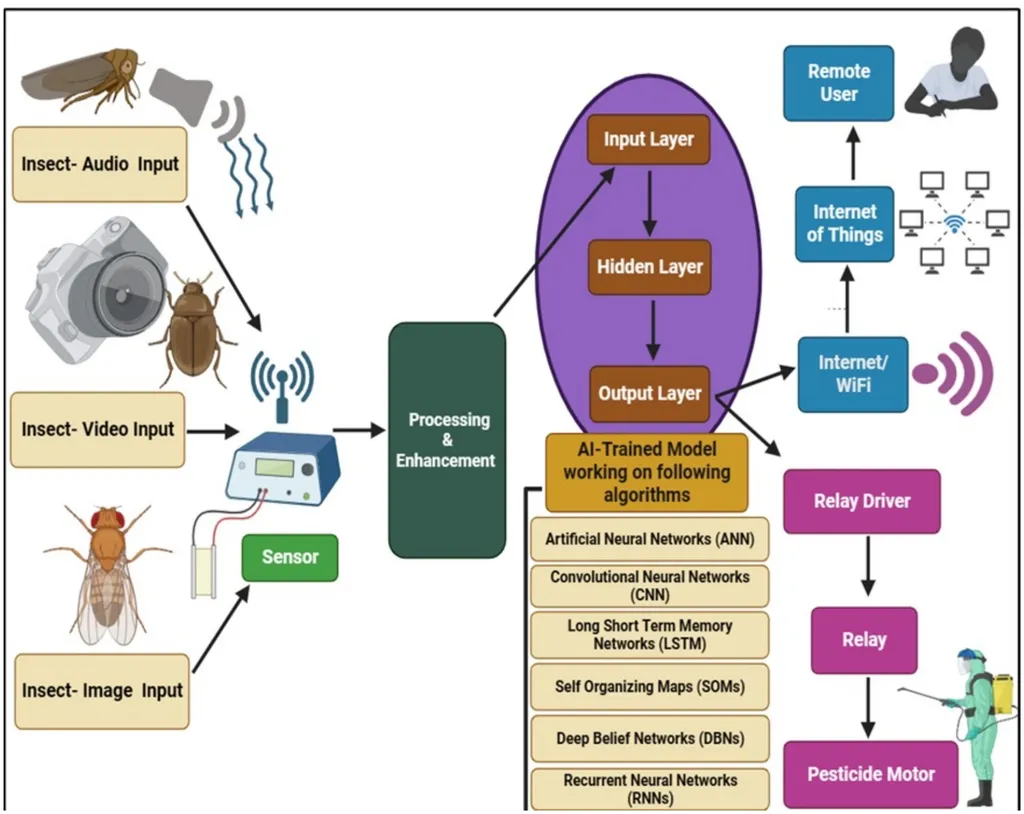
In the ever-evolving landscape of agricultural technology, a groundbreaking development has emerged that promises to revolutionize the way farmers and agronomists tackle one of the industry’s most persistent challenges: stored-grain insect infestations. A recent study published in *ACS Omega* introduces SERAG, or the Smart Enzymatic Reader for Agriculture Grains, a multiplex enzymatic detection kit designed for rapid, on-site diagnosis of mixed stored-grain insect infestations. This innovation could significantly enhance pest management strategies, ultimately safeguarding crop yields and economic stability for farmers worldwide.
The research, led by Ahmed S. Hashem of the Stored Product Pests Research Department at the Plant Protection Research Institute in Egypt, addresses a critical gap in current agricultural practices. Stored-grain insect infestations are a global issue, causing substantial economic losses due to reduced grain quality and quantity. Traditional detection methods are often time-consuming, labor-intensive, and lack the sensitivity required to identify infestations at early stages. SERAG aims to change this paradigm by providing a swift, accurate, and user-friendly diagnostic tool.
“SERAG represents a significant leap forward in agricultural technology,” says Hashem. “By enabling rapid and precise detection of insect infestations, farmers can take immediate action to mitigate damage, thereby preserving grain quality and reducing economic losses.”
The commercial impact of SERAG on the agriculture sector could be profound. Early detection of infestations allows for timely intervention, reducing the need for extensive pesticide use and minimizing environmental impact. This not only aligns with sustainable farming practices but also enhances food safety and security. The technology’s portability and ease of use make it accessible to farmers in both developed and developing regions, democratizing access to advanced pest management tools.
Moreover, the multiplex nature of SERAG enables the simultaneous detection of multiple insect species, a feature that sets it apart from existing diagnostic methods. This capability is crucial for regions where mixed infestations are common, as it provides a comprehensive overview of the pest landscape, allowing for targeted and effective control measures.
The implications of this research extend beyond immediate pest management. As the agricultural sector continues to embrace precision farming and data-driven decision-making, tools like SERAG could become integral components of integrated pest management (IPM) systems. By providing real-time data on pest infestations, SERAG can help farmers optimize their resource allocation, reduce costs, and enhance overall productivity.
Looking ahead, the development of SERAG opens new avenues for research and innovation in agricultural diagnostics. Future iterations of the technology could incorporate additional features, such as connectivity with agricultural management software or integration with other IoT devices, further streamlining pest management processes. The potential for SERAG to be adapted for the detection of other agricultural pests and diseases also warrants exploration, broadening its applicability and impact.
In conclusion, the introduction of SERAG marks a significant milestone in the field of agricultural technology. Its ability to provide rapid, accurate, and on-site diagnosis of stored-grain insect infestations holds immense promise for enhancing pest management strategies and safeguarding agricultural yields. As the technology continues to evolve, it is poised to play a pivotal role in shaping the future of sustainable and efficient farming practices.