
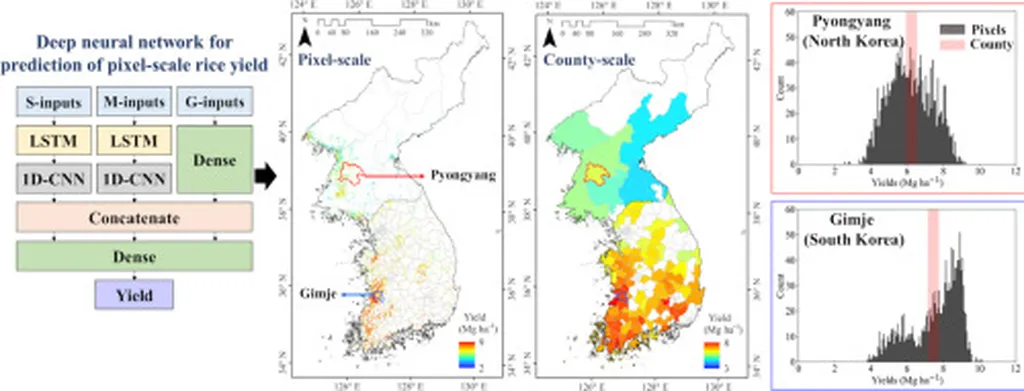
In the quest to optimize rice yields, a team of researchers led by Dasom Jeon from the Rural Development Administration’s National Institute of Agricultural Sciences in South Korea has developed a novel approach to modeling yield variability in the Baromi2 rice cultivar. Their work, recently published in IEEE Access, combines satellite-derived phenological metrics with environmental variables to provide a more comprehensive understanding of what drives rice yields in reclaimed paddy soils.
The team’s modeling framework leverages Sentinel-2 satellite data to derive 15 phenology indicators from smoothed NDVI (Normalized Difference Vegetation Index) trajectories. These indicators are then combined with 52 environmental variables, including soil and topographic factors, to create a robust predictive model. “We wanted to understand how these different factors interact to shape rice yield,” Jeon explains. “By combining phenology, soil, and topographic data, we can gain a more holistic view of the drivers behind yield variability.”
The researchers employed a sequential screening process using Variance Inflation Factor (VIF), Recursive Feature Elimination (RFE), and Permutation Importance (PI) to ensure transparency and control multicollinearity. This process helped them identify the most significant predictors of yield variability. In the phenology-only model, late-season greenness (OffsetV) explained about 62% of yield variation. The environment-only model revealed that soil magnesium (Mg) concentration and altitude were the strongest drivers, with Mg levels above 2 mg/kg lowering yield by roughly 10–12%, and moderate altitudes (0–10 m) raising it by approximately 6%.
When all predictors were combined, the model’s accuracy improved slightly, suggesting that phenology chiefly mediates soil and terrain effects. This finding has significant implications for precision agriculture, as it indicates that phenology and soil variables provide more consistent yield signals than weather aggregates under irrigated and climatically steady conditions.
The commercial impacts of this research are substantial. By understanding the key drivers of yield variability, farmers can make more informed decisions about crop management, potentially leading to increased yields and profitability. “This framework supports precision-agriculture applications and can be adapted across years and cultivars to advance sustainable rice-yield management,” Jeon notes.
The research also highlights the potential of remote sensing and machine learning techniques in agriculture. By leveraging satellite data and advanced modeling frameworks, farmers and agronomists can gain valuable insights into crop performance and make data-driven decisions. This approach not only enhances productivity but also promotes sustainable agricultural practices.
As the agriculture sector continues to evolve, the integration of technology and data-driven insights will play a crucial role in shaping the future of farming. The work of Jeon and her team represents a significant step forward in this direction, offering a powerful tool for optimizing rice yields and advancing sustainable agriculture.