
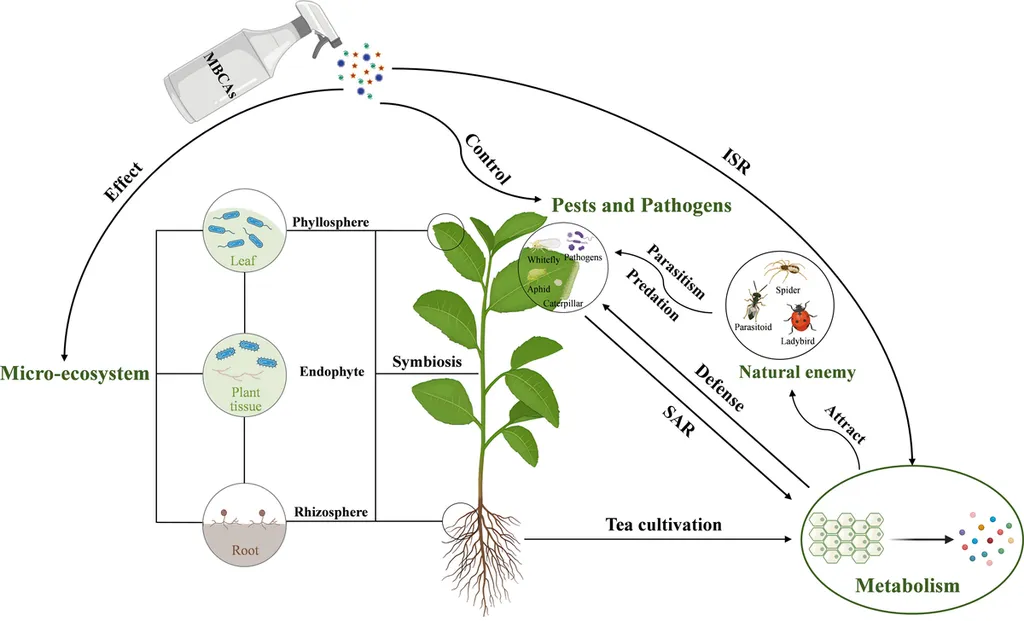
In a groundbreaking study published in *Beverage Plant Research*, researchers have uncovered how leaf metabolites influence the functional composition of the phyllosphere microbiome in tea plants. This research, led by Xiangfeng Tan at the Institute of Digital Agriculture, Zhejiang Academy of Agricultural Sciences, sheds light on the intricate interplay between plant metabolites and microbial communities, offering promising avenues for enhancing agricultural practices.
The phyllosphere, the aerial parts of plants, hosts a diverse microbiome that plays a crucial role in plant health and productivity. However, the mechanisms driving the assembly of this microbiome have remained largely mysterious. Tan and his team investigated the relationship between leaf metabolites and the phyllosphere microbiome in tea plants, a species renowned for its rich metabolic profile. By examining both etiolated (grown in the dark) and non-etiolated tea cultivars, the researchers identified significant variations in the abundance of amino acids and secondary metabolites.
“Etiolated tea cultivars showed particularly enriched levels of theanine, a key amino acid known for its health benefits,” Tan explained. “This enrichment was correlated with the taxonomic composition of the phyllosphere microbiome, suggesting that specific metabolites can shape the microbial communities on the leaf surface.”
The study employed metagenomic analysis to delve deeper into the functional aspects of the microbiome. The researchers found that the composition of functional genes in the microbiome varied with the levels of 12 leaf secondary metabolites. Using machine learning, they pinpointed eight key microbial genes, primarily from the bacterial genera Sphingomonas, Methylobacterium, and Chryseobacterium, that responded to changes in leaf secondary metabolites. Notably, four genes involved in the sulfur biogeochemical cycle—cysK, metZ, betB, and sulP—were highlighted, indicating their potential role in microbiome assembly.
Epigallocatechin gallate and gallic acid, two prominent secondary metabolites in tea, showed broad correlations with the featured genes, suggesting their potential in modulating the functional composition of the phyllosphere microbiome. “These findings provide novel metabolic insights into the mechanisms underlying the phyllosphere microbiome assembly,” Tan noted.
The implications of this research are far-reaching for the agriculture sector. Understanding how leaf metabolites influence the microbiome can lead to the development of targeted strategies to enhance plant health and productivity. For instance, farmers could potentially manipulate the phyllosphere microbiome by adjusting the metabolic profile of their crops, leading to more resilient and productive plants.
Moreover, this research opens new avenues for the development of biofertilizers and biopesticides that harness the power of the phyllosphere microbiome. By identifying key microbial genes and their responses to specific metabolites, scientists can design more effective and sustainable agricultural practices.
As the global demand for sustainable and efficient agricultural practices grows, this study provides a crucial step forward in understanding the complex interactions between plants and their microbial partners. The findings not only advance our scientific knowledge but also offer practical applications that could revolutionize the way we cultivate crops.
In the words of Tan, “This research is just the beginning. The potential applications in agriculture are vast, and we are excited to explore how these insights can be translated into real-world solutions.”
With the publication of this study in *Beverage Plant Research*, the agricultural community is poised to benefit from a deeper understanding of the phyllosphere microbiome and its intricate relationship with plant metabolites. The future of agriculture looks brighter, one metabolite and one microbe at a time.