
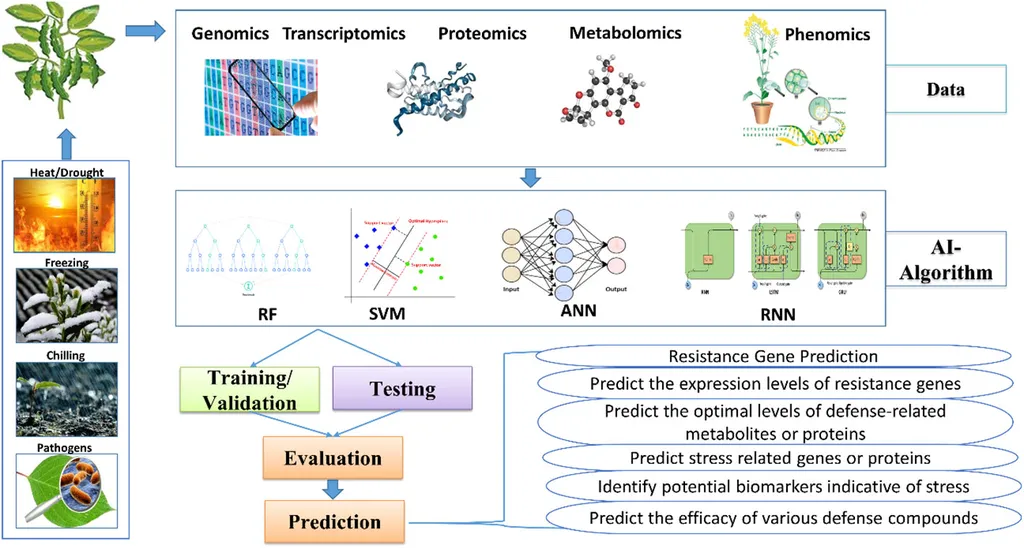
In the relentless pursuit of sustainable agriculture and global food security, understanding how plants cope with environmental stresses is paramount. A recent review published in the *Computational and Structural Biotechnology Journal* sheds light on the molecular mechanisms behind plant stress responses, leveraging cutting-edge protein structure prediction technologies. This research could pave the way for significant advancements in crop resilience and agricultural productivity.
Plants encounter a myriad of environmental stresses, from pathogens and salt exposure to drought, cold, heat, heavy metals, and flooding. These challenges impede growth and reduce agricultural yields. To combat these stresses, plants have evolved intricate adaptive mechanisms, often involving the expression of stress-response proteins. The three-dimensional structures of these proteins hold the key to unlocking the molecular secrets of stress tolerance.
Until recently, large-scale analyses of plant protein structures were hindered by the limited availability of experimentally determined models. However, the advent of advanced protein structure prediction methods—AlphaFold, RoseTTA-Fold, and ESM-fold—has revolutionized the field. These tools now provide hundreds of millions of high-quality predicted 3D models, covering a broad spectrum of plant proteins.
The review, led by Fatima Shahid from the Department of Applied Physics at Universiti Kebangsaan Malaysia, highlights recent structural investigations into plant stress responses. By analyzing diverse paralogs and isoforms, and employing molecular docking and dynamics simulations, researchers are gaining unprecedented insights into the mechanisms of stress-modulating proteins.
“Exploring the structures of these proteins together with their inferred functions can aid improvements in crop productivity, foster sustainable agriculture, and contribute to global food security efforts,” Shahid explained. This research not only enhances our understanding of plant stress responses but also offers practical applications for the agriculture sector.
The commercial implications of this research are substantial. By identifying and characterizing stress-tolerance mechanisms at the molecular level, scientists can develop crops that are more resilient to environmental stresses. This could lead to higher yields, reduced crop losses, and more sustainable farming practices. Additionally, the insights gained from structural analyses can inform the development of new agricultural technologies and biotechnological interventions.
Looking ahead, the integration of experimental and predicted structural data holds immense potential for future developments. As protein structure prediction technologies continue to evolve, researchers will be better equipped to tackle the complex challenges posed by environmental stresses. This could usher in a new era of precision agriculture, where crops are tailored to thrive in diverse and challenging conditions.
In summary, the review underscores the transformative power of protein structure-based analyses in unraveling the mysteries of plant stress responses. By harnessing the capabilities of advanced prediction methods, researchers are poised to make significant strides in enhancing crop resilience and agricultural productivity. This research not only advances our scientific understanding but also offers tangible benefits for the agriculture sector, contributing to a more sustainable and food-secure future.