
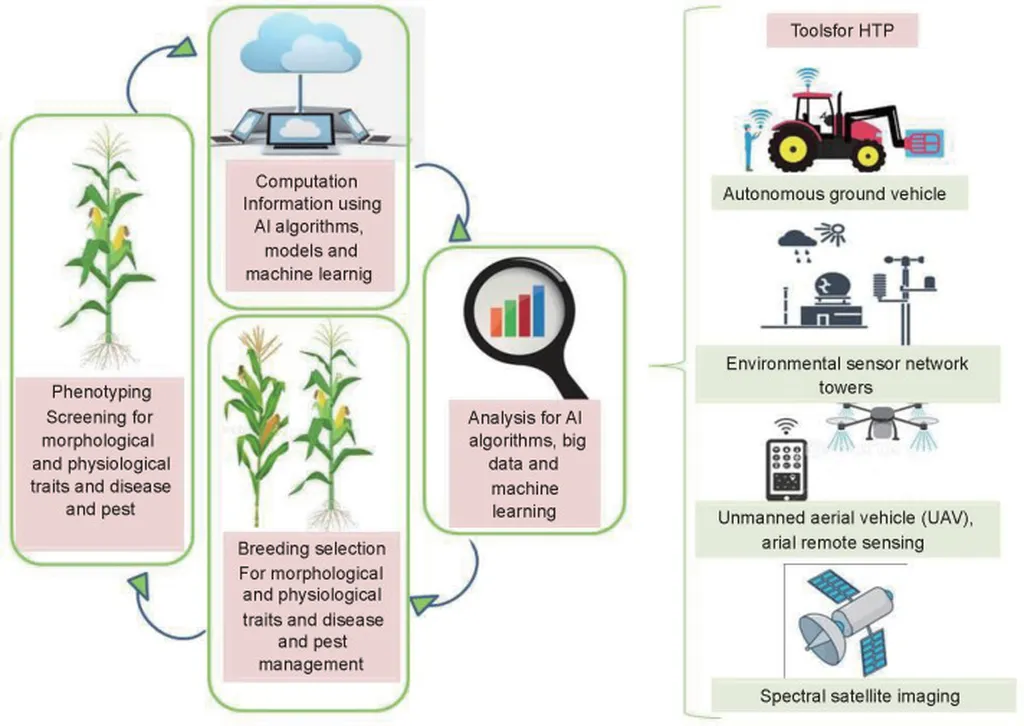
In the rapidly evolving world of agricultural technology, a groundbreaking study has emerged that could revolutionize how we identify and manage plant varieties. Published in the *Plant Phenome Journal*, the research, led by Rijad Sarić from the La Trobe Institute for Sustainable Agriculture & Food (LISAF) at La Trobe University in Melbourne, Australia, introduces a sophisticated pipeline for accurately recognizing different ecotypes of Arabidopsis thaliana using computer vision and deep learning models. This innovation holds significant promise for the agriculture sector, particularly in enhancing genetic breeding programs and improving management practices for both indoor and outdoor production systems.
The study addresses a critical challenge in biological research: the misidentification of cell lines or ecotypes/varieties. With the 1000 Arabidopsis Genome Project facilitating the use of numerous ecotypes, verifying the identity of these ecotypes in large-scale genetic screens is more important than ever. Sarić and his team developed an RGB image analysis pipeline that not only accurately recognizes different ecotypes but also provides a robust framework for data complexity assessment and model optimization.
The pipeline’s success hinges on several key aspects. First, it assesses data complexity using spatial-temporal features of the RGB spectrum and data entropy, which measures the variability within the dataset. “This step is crucial because high variability can complicate the training of deep learning models,” explains Sarić. If the data complexity is high, the pipeline redefines the data to ensure accuracy. Additionally, the pipeline partitions data based on morphological similarity among ecotype replicates, further enhancing the precision of the models.
One of the most innovative features of the pipeline is its integration of several supervised deep learning models into an auto-optimization subsystem. Extensive hyperparameter tuning was performed to identify the best-performing models for both single-image and image-sequence ecotype classification. The robustness of the pipeline was demonstrated using two external datasets, showcasing its ability to handle data collected under various conditions.
For the agriculture sector, the implications of this research are profound. Accurate identification of plant varieties can streamline genetic breeding programs, leading to the development of crops with desirable traits such as disease resistance, drought tolerance, and higher yields. “This technology can significantly reduce the time and resources spent on manual identification and verification processes,” says Sarić. Moreover, the pipeline’s ability to extract traits for further analysis and correlation can enhance management practices, optimizing both indoor and outdoor production systems.
The study also provides a graphical user interface to prepare images for input into the pipeline, addressing cases of extreme variability. This user-friendly feature makes the technology accessible to a broader range of users, from researchers to agricultural practitioners.
As we look to the future, the potential applications of this research extend beyond Arabidopsis thaliana. The principles and methodologies developed in this study could be adapted for other plant species, paving the way for more efficient and accurate phenotyping across the agricultural landscape. The integration of computer vision and deep learning models into agricultural practices represents a significant step forward in the precision agriculture revolution, offering new opportunities for innovation and growth in the sector.
In summary, the research led by Rijad Sarić and published in the *Plant Phenome Journal* marks a significant advancement in the field of plant phenotyping. By leveraging cutting-edge technology, this study not only addresses a critical challenge in biological research but also opens up new possibilities for the agriculture sector. As the industry continues to evolve, the integration of such innovative solutions will be key to meeting the growing demands for sustainable and efficient food production.