
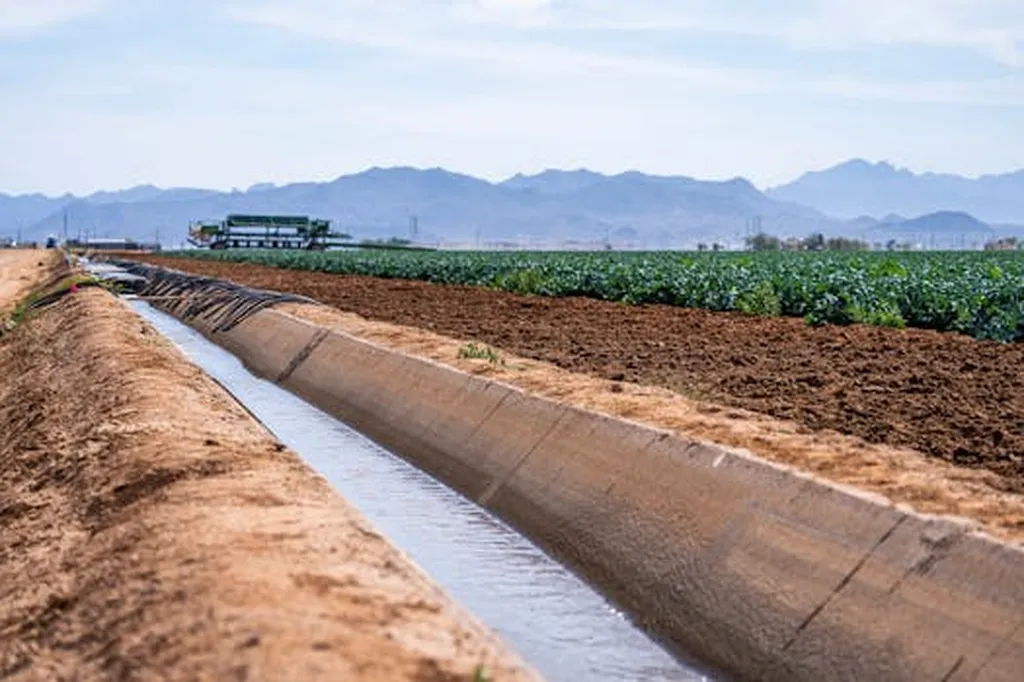
In the heart of arid and remote regions, where water is a precious commodity, a groundbreaking solution is emerging to revolutionize agricultural water management. Researchers have developed an AI-driven digital twin framework that optimizes the performance of solar-powered submersible pumps, offering a promising tool for farmers and water managers in challenging environments.
The research, published in the journal ‘Inventions’ and led by Yousef Salah from the Research and Innovation Center at the Arab Academy for Science, Technology and Maritime Transport in Egypt, addresses a critical need: reliable water access in areas with limited infrastructure. Solar-powered submersible pumps have long been a viable solution, but their performance has been hampered by variable environmental conditions. This new framework changes the game.
At the core of this innovation are three key components: an AI model that predicts the inverter motor’s output frequency based on solar panel output, a predictive model that estimates the pump’s generated power, and a mathematical formulation that determines the volume of water lifted. The system integrates real-world data with a multi-phase AI modeling pipeline, enabling real-time water output estimation.
The research team collected six months of environmental and system performance data to train and evaluate multiple predictive models. The results were impressive. The Random Forest (RF) model outperformed alternatives, achieving a Mean Absolute Error (MAE) of just 1.00 Hz for output frequency prediction and 1.39 kW for pump output power prediction. This level of accuracy is a game-changer for agricultural planning.
“Our framework successfully estimated an annual water delivery of 166,132.77 cubic meters, with peak monthly output in July and minimum in January,” said Salah. “This practical applicability demonstrates the potential for enhancing agricultural water management in arid regions.”
The commercial impacts for the agriculture sector are substantial. Farmers in remote and desert-like regions can now better plan and manage their water resources, ensuring more efficient and sustainable irrigation. This technology can also reduce operational costs and improve the reliability of solar-powered submersible pumps, making them a more attractive option for agricultural applications.
Looking ahead, this research could shape future developments in the field of digital twins and AI-driven modeling. The integration of real-world data with advanced predictive models opens new avenues for optimizing various agricultural systems. As the technology evolves, we can expect to see even more sophisticated applications, from precision farming to water resource management.
In the words of Salah, “This is just the beginning. The potential for AI-driven digital twins in agriculture is vast, and we are excited to explore further innovations that can benefit farmers and communities worldwide.”
As we stand on the brink of a new era in agricultural technology, this research offers a glimpse into a future where AI and renewable energy combine to create sustainable and efficient solutions for some of the world’s most pressing challenges.