
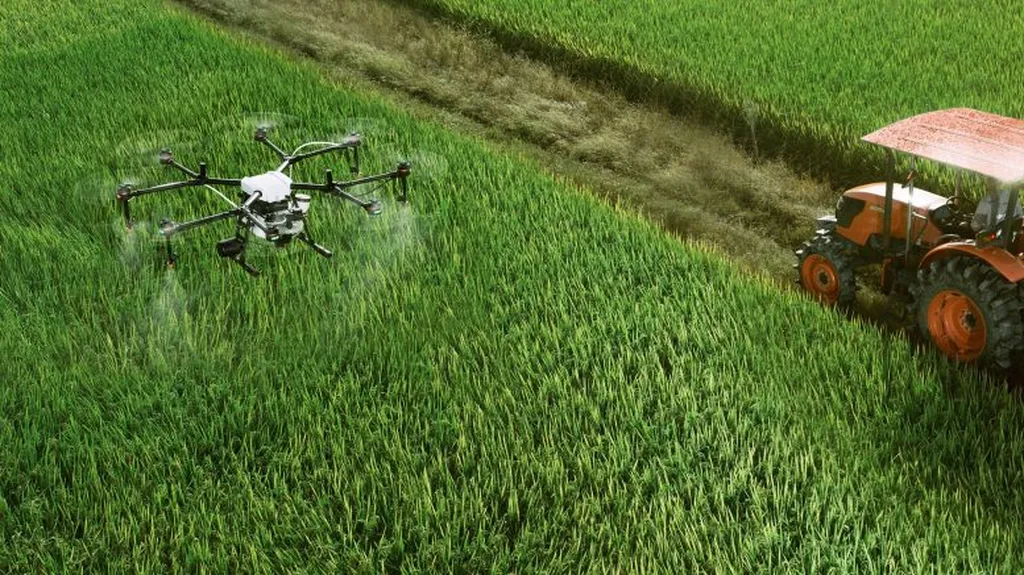
In the heart of Brazil, researchers are harnessing the power of artificial intelligence and aerial imagery to revolutionize forage management, potentially transforming the agricultural sector. A recent study published in *AgriEngineering* demonstrates how machine learning models can predict key structural traits and chemical composition of *Urochloa decumbens*, a vital forage species, using data from unmanned aerial vehicles (UAVs).
The research, led by Iuly Francisca Rodrigues de Souza from the Department of Animal Science at the Federal University of Viçosa, explored the use of multispectral imagery to train predictive models for various forage parameters. The team applied different nitrogen doses to promote variability in the pastures, creating a robust dataset for model training.
The findings reveal promising results for certain parameters. The Random Forest Regressor (RFR) model excelled in predicting fresh forage mass, achieving an impressive R-squared value of 0.82. Meanwhile, the Support Vector Regressor (SVR) model showed strong performance in predicting dry forage mass, with an R-squared value of 0.68. “These results indicate that machine learning models can be powerful tools for forage management,” said Souza. “They allow us to monitor and predict key parameters with remarkable accuracy, which can greatly enhance decision-making processes in agriculture.”
The study also highlighted the potential of Multiple Linear Regression (MLR) for predicting dry matter concentration, with an R-squared value of 0.64. However, the models showed moderate performance for forage density and limited accuracy for canopy height. Crude protein prediction proved to be a challenge, suggesting the need for hyperspectral sensors to capture more detailed spectral information.
The commercial implications of this research are substantial. By enabling precise monitoring of forage quality and quantity, these models can help farmers optimize their resources, reduce costs, and improve overall productivity. “This technology can be a game-changer for the agriculture sector,” said Souza. “It allows for more efficient use of inputs, better planning, and ultimately, increased profitability.”
Looking ahead, the researchers emphasize the need to expand temporal and spatial data variability and integrate different sensor types to increase model robustness. This could pave the way for even more accurate and reliable predictions, further enhancing the potential of remote sensing and machine learning in agriculture.
As the field of precision agriculture continues to evolve, studies like this one are crucial in driving innovation and shaping the future of farming. By leveraging advanced technologies, farmers can achieve greater efficiency, sustainability, and profitability, ultimately contributing to a more resilient and productive agricultural sector.