
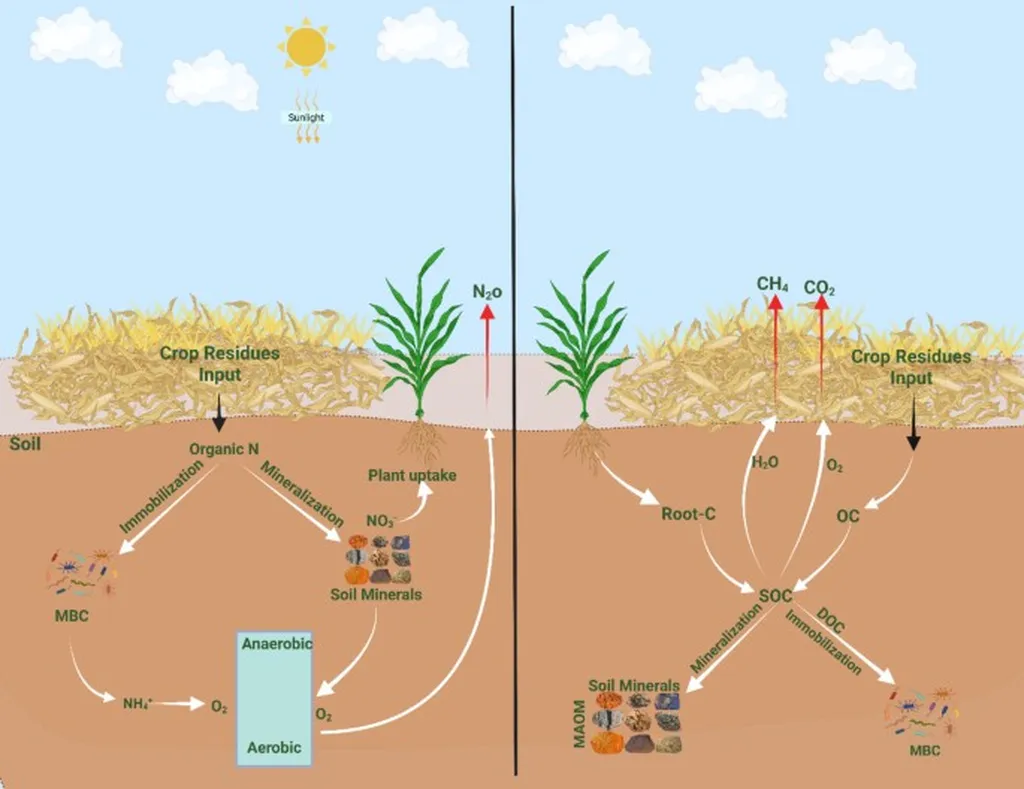
In the quest for sustainable agriculture, farmers and researchers are constantly seeking ways to enhance soil health while minimizing environmental impacts. A recent study published in *Agrosystems, Geosciences & Environment* sheds light on how different organic input strategies can influence greenhouse gas (GHG) emissions in semiarid regions, offering valuable insights for the agriculture sector.
The study, led by Morad Mirzaei from the School of Natural Sciences at Trinity College Dublin, investigated the effects of barley residues (BR), sheep manure (SM), and their combination (BR+SM) on soil carbon dioxide (CO2) and nitrous oxide (N2O) emissions under maize and mungbean crops in Iran’s semiarid region. The findings reveal nuanced interactions between soil management practices and environmental sustainability.
According to the research, the application of sheep manure and the combination of barley residues with sheep manure resulted in higher CO2 fluxes in mungbean crops compared to barley residues alone. However, in maize, cumulative CO2 emissions were similar across all treatments. Notably, the combination of barley residues and sheep manure led to higher soil N2O values in mungbean compared to the other treatments.
The study highlights that the application of barley residues alone resulted in the lowest cumulative CO2 and N2O emissions under both crops. Specifically, cumulative CO2 fluxes were 21.5% and 53.5% lower in the barley residues treatment compared to the combined treatment under maize and mungbean, respectively. Similarly, cumulative N2O emissions were 48% lower in the barley residues treatment compared to the combined treatment under mungbean.
These findings suggest that barley residues can be an effective alternative management strategy for lowering GHG emissions in semiarid cropping systems. “Our study provides key insights for enhancing agricultural sustainability while reducing GHG emissions,” Mirzaei noted. “By exploring the impact of organic input management on soil carbon and nitrogen dynamics, we can make informed decisions that benefit both farmers and the environment.”
The commercial implications of this research are significant. Farmers in semiarid regions can potentially reduce their carbon footprint and contribute to mitigating climate change by adopting barley residue application strategies. This practice not only enhances soil quality but also aligns with the growing demand for sustainable and environmentally friendly agricultural practices.
As the agriculture sector continues to evolve, the findings from this study could shape future developments in soil management and GHG emission reduction strategies. By integrating organic input management practices that are both effective and sustainable, farmers can achieve a balance between productivity and environmental stewardship.
In an era where climate change and sustainability are at the forefront of global concerns, this research offers a practical and scientifically grounded approach to improving agricultural practices. As Morad Mirzaei and his team continue to explore the intricacies of soil management, their work provides a beacon of hope for a more sustainable future in agriculture.