
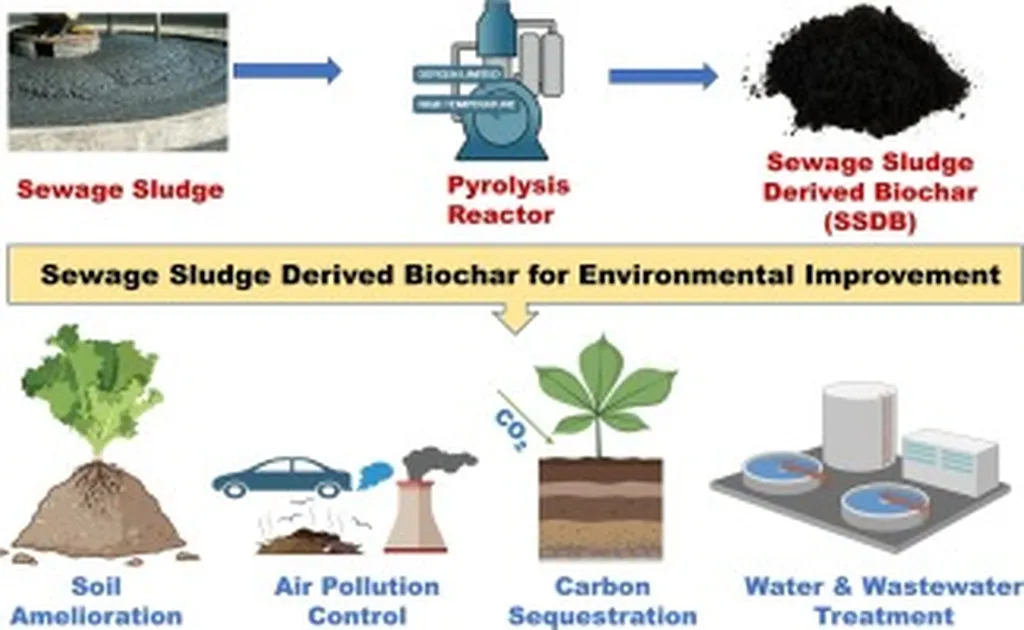
In the quest to combat climate change and promote sustainable agriculture, scientists are turning to an unconventional hero: biochar. A recent study published in *Next Sustainability* has shed new light on how biochar, derived from waste sewage sludge, can significantly enhance soil carbon sequestration, offering a promising avenue for farmers and environmentalists alike.
The research, led by Jhon Kenedy Moura Chagas from the Faculdade de Agronomia e Medicina Veterinária at the Universidade de Brasília, combines a comprehensive meta-analysis with a long-term field trial in tropical soils. The study’s dual approach provides a robust evaluation of biochar’s potential to boost soil carbon levels and mitigate climate change.
The meta-analysis, which reviewed 586 paired comparisons from 169 studies, revealed that biochar application consistently increased total carbon (TC) and various soil carbon fractions. This global perspective sets the stage for understanding the local impacts, which were explored through a four-year field trial in tropical soils.
In the field experiment, biochar produced from sewage sludge at two different pyrolysis temperatures—300°C (SSB300) and 500°C (SSB500)—was applied to the soil. The results showed modest increases in total carbon, with SSB300 yielding a 7.7% increase and SSB500 a 0.7% increase. While these numbers might seem small, they are significant when compared to other agricultural practices.
“Even though the increases might appear modest, the absolute gain in total carbon with SSB300 surpassed those achieved through practices like no-till farming,” Chagas explained. “This underscores the potential of biochar as a tool for soil carbon sequestration.”
The study highlights the importance of tailoring biochar applications to local conditions and optimizing pyrolysis temperatures to maximize carbon sequestration. This context-specific approach could revolutionize waste management, promote sustainable agriculture, and contribute to climate change mitigation.
For the agriculture sector, the implications are substantial. Farmers could potentially enhance soil fertility and carbon sequestration by integrating biochar into their practices. This not only improves crop yields but also opens up new revenue streams through carbon credits. As the global push for sustainable practices intensifies, biochar could become a valuable asset for farmers looking to adapt and thrive in a changing climate.
The research also points to the need for further studies to refine biochar production and application methods. As Chagas noted, “Understanding the local context is crucial. What works in one region might not work in another. We need to continue exploring and adapting these techniques to different environments.”
In the broader context, this study could shape future developments in agritech and environmental science. By bridging the gap between global data and local application, researchers and farmers can work together to develop more effective and sustainable agricultural practices. The journey towards carbon-neutral farming is complex, but with innovations like biochar, the path becomes clearer and more achievable.
As the world grapples with the challenges of climate change and sustainable resource management, studies like this offer hope and practical solutions. The integration of biochar into agricultural practices could be a game-changer, providing a win-win scenario for farmers, the environment, and the planet.