
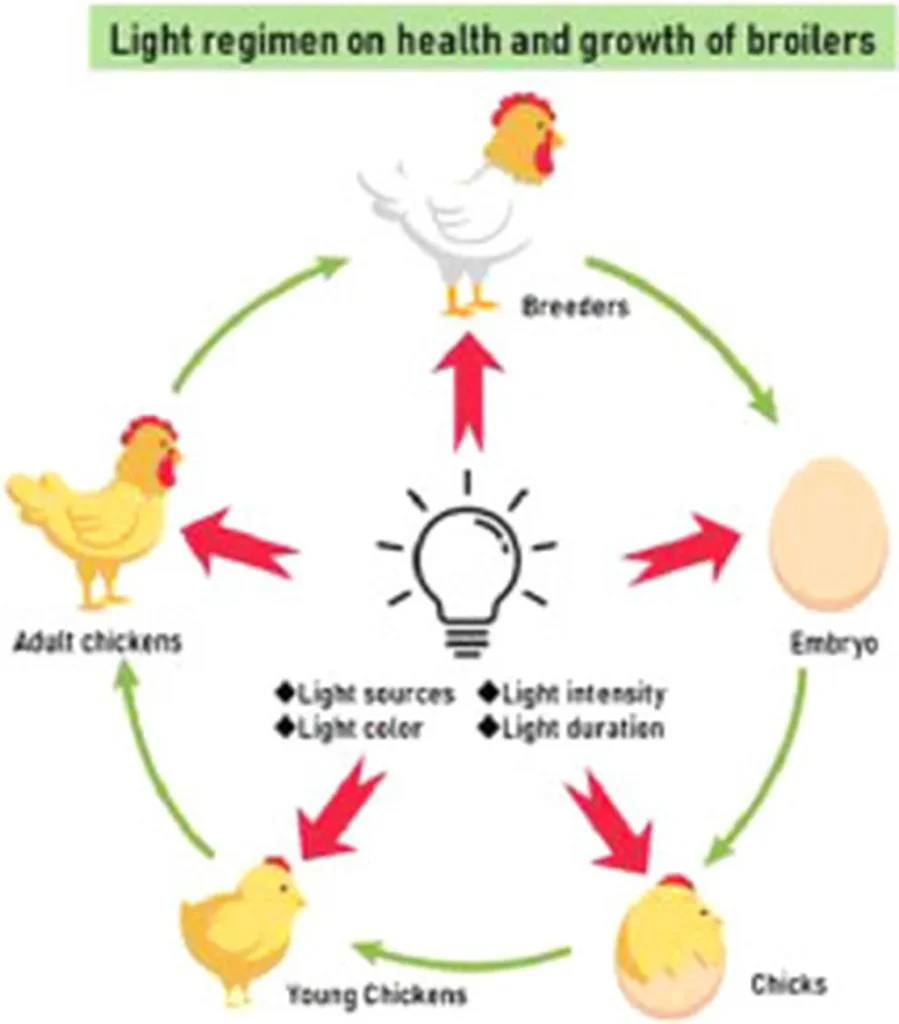
In a groundbreaking study published in *Poultry Science*, researchers have uncovered a novel mechanism by which monochromatic light influences the intestinal health of broiler chickens. The study, led by Wanqi Tang from the State Key Laboratory of Veterinary Public Health and College of Veterinary Medicine at China Agricultural University, sheds light on how different light colors can impact broiler growth and intestinal function, offering promising insights for sustainable agriculture.
The research team exposed broilers to four different light colors: white, blue, green, and red. They found that blue and green light significantly elevated plasma melatonin concentrations, a hormone known for its high photosensitivity in broilers. This elevation was associated with improved jejunal function, as evidenced by increased broiler weight, villus height, and the villus height to crypt depth ratio (V/C), along with decreased crypt depth. “The improvements in intestinal function were quite remarkable,” noted Tang. “Broilers under blue and green light showed better overall health and growth compared to those under red light.”
The study also revealed that blue and green light up-regulated the expression of genes crucial for intestinal barrier function and nutrient absorption, such as Claudin1, Occludin, ZO-1, Pept1, SglT1, Si, and Cat1, while down-regulating Cat2 expression. Additionally, these light conditions increased the number of goblet cells and IgA-positive cells, which are essential for maintaining gut immunity. The researchers observed elevated levels of Muc2, SOD, CAT, and GSH-Px, indicating a reduction in oxidative stress and improved antioxidant defenses.
One of the most intriguing findings was the role of the pineal gland. When the researchers removed the pineal gland (pinealectomy), the differences among the light groups disappeared, and the broilers’ intestinal function deteriorated. This suggests that the pineal gland and its production of melatonin are crucial for the beneficial effects of blue and green light on gut health.
Further experiments demonstrated that melatonin improved jejunal function by suppressing intestinal cell apoptosis rather than promoting cell proliferation. In vitro studies indicated that melatonin exerts its anti-apoptotic effects primarily through the Mel1b receptor. “This pathway could be a key target for future interventions aimed at improving gut health in broilers,” Tang explained.
The implications of this research for the agriculture sector are substantial. As the industry moves towards antibiotic-free and sustainable practices, understanding how light can influence gut health offers a promising alternative to traditional methods. By optimizing lighting conditions, farmers could enhance broiler growth and intestinal function without relying on antibiotics, leading to healthier birds and more sustainable production.
This study not only provides a theoretical foundation for the effects of monochromatic light on melatonin production and gut function but also opens the door for practical applications in poultry farming. As Tang concluded, “Our findings suggest that monochromatic light could be a valuable tool in sustainable animal agriculture, offering a non-invasive and effective way to improve gut health and broiler production.”