
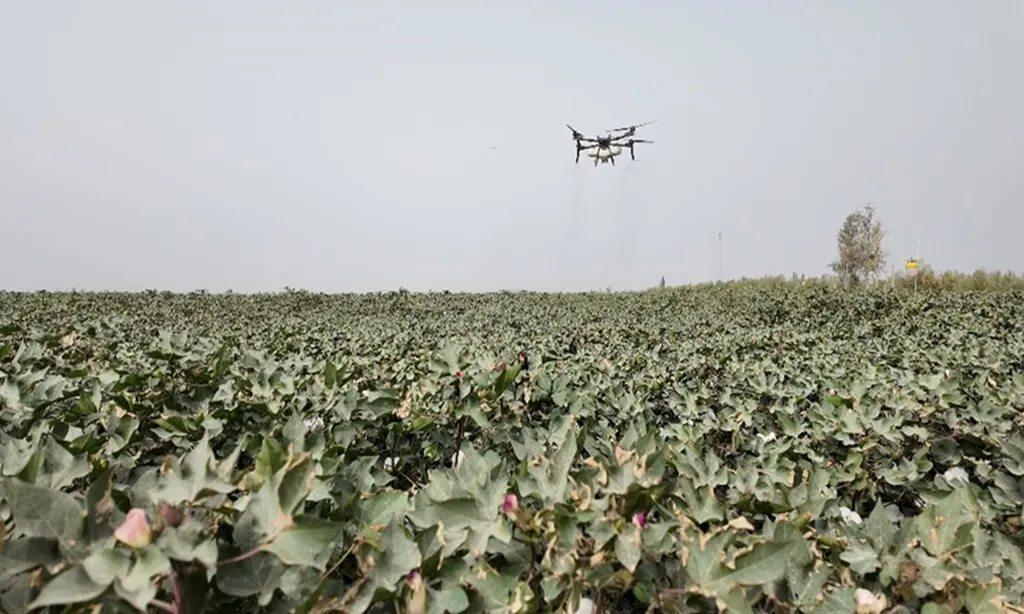
In the heart of China’s arid Xinjiang region, a groundbreaking approach to irrigation is taking root, promising to revolutionize water management in agriculture. Researchers have developed an intelligent irrigation scheduling method that could significantly boost water use efficiency while maintaining, or even increasing, crop yields. This innovation, published in the journal *Agriculture*, combines a sophisticated crop growth model with advanced deep reinforcement learning (DRL) techniques, offering a beacon of hope for farmers grappling with water scarcity.
The method, spearheaded by Jiamei Liu from the School of Information Science and Engineering at Zhejiang Sci-Tech University, leverages the Decision Support System for Agrotechnology Transfer (DSSAT) model to simulate cotton growth with remarkable accuracy. By calibrating the model with local data from the Shihezi region, the team created a high-fidelity digital twin of the cotton crop, providing a reliable platform for training their DRL agent.
At the core of this innovation lies a temporal state representation module, which uses a Bidirectional Long Short-Term Memory (BiLSTM) network and an attention mechanism to capture dynamic trends in historical environmental information. This module enables the system to focus on critical decision factors, such as soil moisture levels and weather patterns, to make informed irrigation decisions.
“We wanted to create a system that could learn and adapt to the dynamic needs of the crop, rather than relying on fixed schedules or empirical knowledge,” Liu explained. “By doing so, we can optimize water use and improve yields, even in the most challenging environments.”
The researchers also enhanced the Soft Actor–Critic (SAC) algorithm by integrating a feature attention mechanism, further refining the system’s decision-making precision. A dynamic reward function, designed based on the critical growth stages of cotton, ensures that the system’s objectives align with agronomic best practices.
The results are impressive. The proposed method improved water use efficiency (WUE) by 39.0%, achieving an 8.4% increase in yield and a 22.1% reduction in water consumption compared to fixed-schedule irrigation strategies. An ablation study confirmed that each component of the system—BiLSTM, the attention mechanism, and the dynamic reward—plays a significant role in its overall performance.
The commercial implications of this research are substantial. In an era of climate change and water scarcity, farmers are under increasing pressure to optimize their resource use. This intelligent irrigation system offers a practical solution, enabling farmers to maximize their yields while minimizing water waste. As the technology matures, it could be adapted for use with a wide range of crops, further broadening its impact.
Moreover, the integration of crop models with advanced machine learning techniques opens up new avenues for research and development in the field of precision agriculture. By creating high-fidelity digital twins of crops, researchers can explore a vast range of scenarios and strategies, accelerating the pace of innovation and discovery.
As Liu noted, “This is just the beginning. We believe that by combining crop models with advanced machine learning techniques, we can unlock new possibilities for sustainable and efficient agriculture.”
In the fight against water scarcity, this intelligent irrigation system represents a significant step forward, offering hope for a more sustainable and productive future for farmers worldwide. With further research and development, it could play a pivotal role in shaping the future of agriculture, helping to feed a growing population in the face of increasingly challenging environmental conditions.