
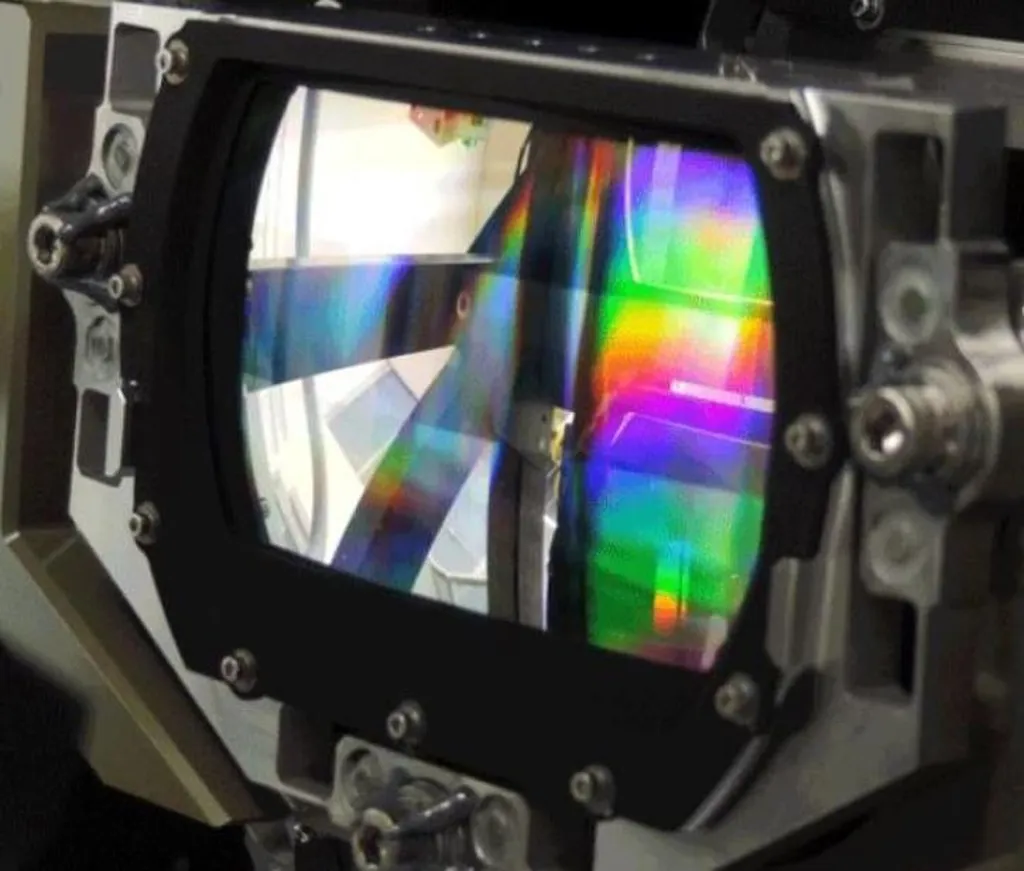
In a significant stride towards making hyperspectral imaging more accessible and practical, researchers have developed a compact, lightweight, and cost-effective hyperspectral camera. This innovation, detailed in a study published in *Sensors*, leverages Schwarzschild reflector systems and commercial off-the-shelf (COTS) components, addressing longstanding challenges in the field.
Hyperspectral imaging, a technology that captures image data at different wavelengths across the electromagnetic spectrum, has been a game-changer in precision agriculture, environmental monitoring, and mineral exploration. However, the high cost, large size, and complexity of current systems have limited their widespread adoption. The new camera, developed by a team led by Shuai Yuan at the Aerospace Information Research Institute, Chinese Academy of Sciences, aims to overcome these barriers.
The camera’s design is based on a Schwarzschild configuration, an optical system that uses curved mirrors to form images. This all-reflective system eliminates chromatic aberration and minimizes energy loss, resulting in an integration time as short as several milliseconds and a push-broom frame rate of 200 frames per second. The optical design was optimized and verified using simulations, ensuring highly concentrated spot sizes at all field positions and controlling critical distortions within several pixels.
“The optical path length theory and the unobscured Schwarzschild structure allowed us to optimize off-axis mirrors and a plane grating,” Yuan explained. “This resulted in a system that is not only compact and lightweight but also highly efficient.”
The prototype, assembled on a precision optical bench and integrated into a precisely machined housing, weighs less than 2 kg. Calibration verified a spectral coverage of 400–1000 nm and a resolution of 5 nm. Imaging experiments demonstrated the system’s ability to resolve subtle spectral features, successfully distinguishing different vegetations and artificial materials based on their spectral signatures.
For the agriculture sector, this development could be transformative. Precision agriculture relies heavily on accurate and timely data to optimize crop management, detect diseases, and monitor soil health. The compact and cost-effective nature of this new hyperspectral camera could make it feasible for farmers to deploy such technology on a larger scale, leading to more efficient and sustainable farming practices.
“The potential applications of this technology are vast,” said Yuan. “From precision agriculture to environmental monitoring and mineral exploration, this camera offers a high-performance, low-cost solution.”
The study’s findings suggest that future developments in hyperspectral imaging could focus on further miniaturization and cost reduction, making the technology even more accessible. As the agriculture sector continues to embrace digital transformation, innovations like this compact hyperspectral camera could play a pivotal role in shaping the future of farming.
The research, led by Shuai Yuan from the Aerospace Information Research Institute, Chinese Academy of Sciences, was published in the journal *Sensors*, highlighting the potential of this technology to revolutionize various fields, including precision agriculture.