
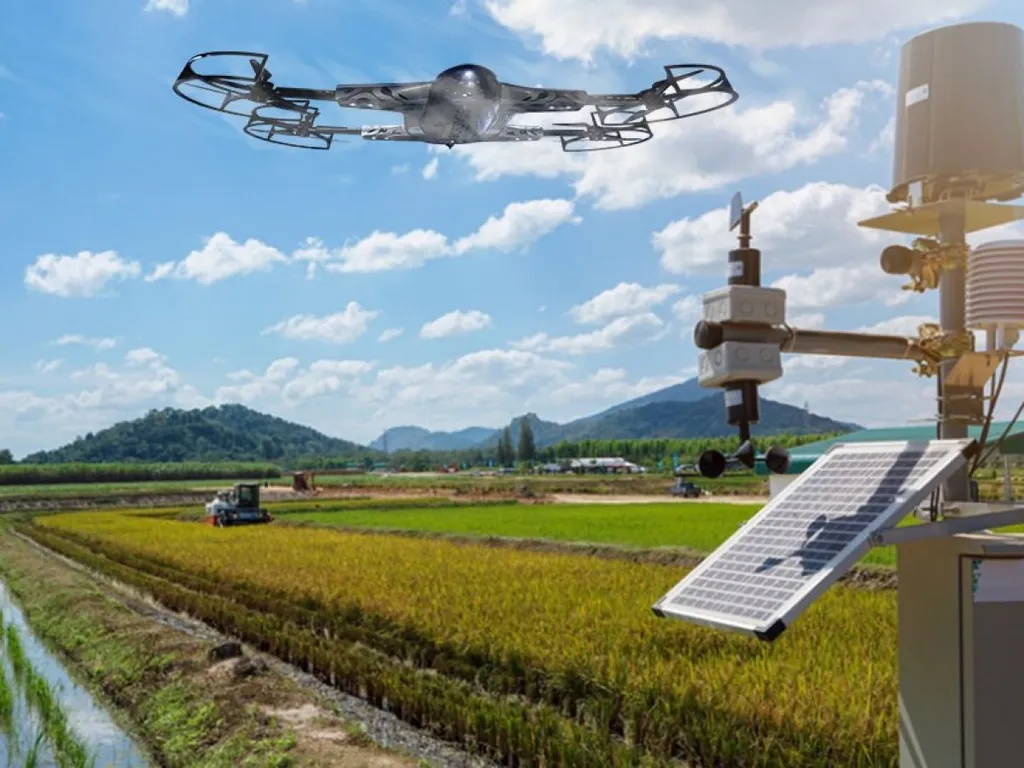
In the ever-evolving landscape of agricultural technology, drones have emerged as a game-changer, offering farmers a bird’s-eye view of their fields and enabling precision management like never before. A recent review published in *Modern Agriculture* delves into the multifaceted applications of drones in agriculture, highlighting their role in enhancing productivity and efficiency. The study, led by Chetan Yumnam from the ICAR–Central Institute of Agricultural Engineering in Bhopal, India, provides a comprehensive overview of drone technology, from the types of drones and their sensors to the advanced data processing techniques that make them invaluable tools for modern farmers.
Drones have become indispensable in agriculture, tackling a range of tasks from chemical spraying and fertiliser application to irrigation management and soil analysis. “Drones reduce laborious tasks, lower input costs, and save operational time,” Yumnam notes, underscoring the immediate benefits for farmers. By capturing real-time data of crops and farmland, drones enable early detection of issues, allowing for timely interventions that can significantly boost agricultural output.
The review categorises drones into several groups, including fixed-wing, multi-rotor, hybrid, remote piloted, autonomous, surveillance, spraying, and payload-specific drones. Each type is equipped with a variety of sensors—such as red-blue-green (RGB), multispectral, hyperspectral, thermal, spectrophotometer, radiometer, and light detection and ranging (LiDAR)—that capture detailed images of the farmland. These images are then processed using advanced data analytics, including deep learning and machine learning, to extract valuable insights.
Vegetation indices like the normalised difference vegetation index (NDVI), excess greenness index (ExG), normalised difference index (NDI), and ratio of vegetation index (RVI) are employed to differentiate objects and distinguish crops from soil backgrounds. These indices are crucial for monitoring crop health and identifying areas that require attention, ultimately leading to more informed decision-making.
The commercial impact of drone technology in agriculture is substantial. By automating labor-intensive tasks, drones reduce the need for manual labour, cutting costs and increasing efficiency. The ability to monitor large areas of farmland quickly and accurately also means that issues such as pest infestations, disease outbreaks, and nutrient deficiencies can be detected and addressed before they escalate, preventing potential losses.
Moreover, the data collected by drones can be used to optimise the use of resources such as water and fertilisers, leading to more sustainable farming practices. This not only benefits the environment but also improves the bottom line for farmers by reducing waste and maximising yields.
However, the review also highlights existing challenges and considerations for future advancements. Issues such as regulatory frameworks, data privacy, and the need for skilled operators are areas that require attention. As the technology continues to evolve, addressing these challenges will be crucial for the widespread adoption of drones in agriculture.
The research by Yumnam and his team offers a glimpse into the future of farming, where drones play a central role in precision agriculture. By leveraging the latest advancements in sensor technology and data analytics, farmers can look forward to a more efficient, sustainable, and profitable future. As the agricultural sector continues to embrace technology, the potential for drones to revolutionise the way we grow our food is immense, promising a future where innovation and tradition converge to feed the world.