
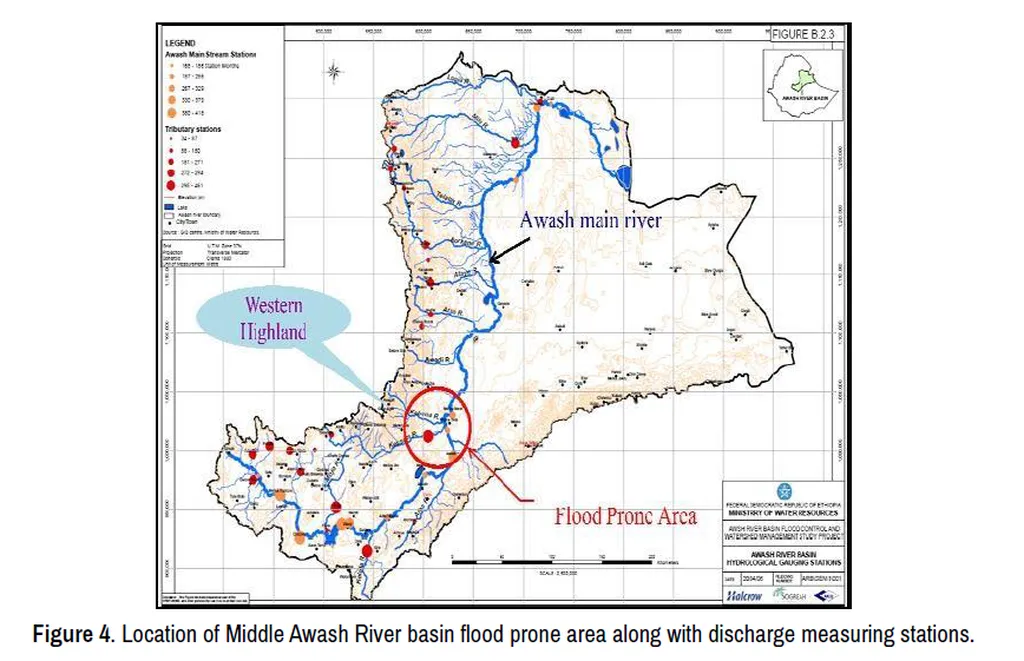
In the heart of Ethiopia’s Awash Basin, a delicate dance between land use and water resources is unfolding, one that could redefine agricultural strategies in semi-arid regions worldwide. A recent study published in *Agronomy* has shed light on the intricate dynamics at play, offering a roadmap for sustainable agriculture that balances crop production with environmental conservation.
The research, led by Tewekel Melese Gemechu of the State Key Laboratory of Resource and Environmental Information System at the Chinese Academy of Sciences, delves into the multi-decadal impact of land use changes on water resources crucial for agriculture. By harnessing satellite-derived data and advanced hydrological modeling, the study provides a comprehensive assessment of how shifting landscapes influence water availability.
The Awash Basin, a vital agricultural hub, has witnessed rapid changes in land use over the past two decades. Gemechu and his team analyzed these changes, revealing a two-phase transition: an initial period of rapid cropland expansion and urbanization (2001–2010), followed by a notable recovery of woodlands (2010–2020). This latter phase is attributed to national initiatives like Ethiopia’s Green Legacy Initiative, which aims to restore forest cover.
The implications for agricultural water management are profound. Early land use changes increased surface runoff, potentially boosting reservoir storage for large-scale irrigation—a boon for commercial agriculture. However, the later shift towards enhanced subsurface flow suggests a move towards groundwater recharge, crucial for small-scale and well-based irrigation systems.
“Our findings demonstrate that land use trajectories directly alter the partitioning of agricultural water sources,” Gemechu explains. This insight is critical for designing sustainable land and water management strategies. By understanding these dynamics, farmers and policymakers can make informed decisions that ensure water security while supporting agricultural productivity.
The study also highlights the role of evapotranspiration (ET) trends in this complex interplay. Urbanization was found to suppress water fluxes, while woodland recovery fostered their resurgence. These trends, validated against global datasets, underscore the importance of balancing urban development with forest conservation to maintain water availability for agriculture.
For the agriculture sector, the research offers a blueprint for adapting to changing land use patterns. By integrating these findings into water management strategies, farmers can optimize irrigation practices, ensuring sustainable crop production. Policymakers, too, can leverage this knowledge to design initiatives that promote both agricultural growth and environmental conservation.
As the world grapples with the challenges of climate change and water scarcity, the insights from this study are more relevant than ever. By understanding the intricate relationship between land use and water resources, we can pave the way for a more sustainable future for agriculture. Gemechu’s research not only informs current practices but also shapes future developments in the field, offering a beacon of hope for sustainable agriculture in semi-arid regions.