
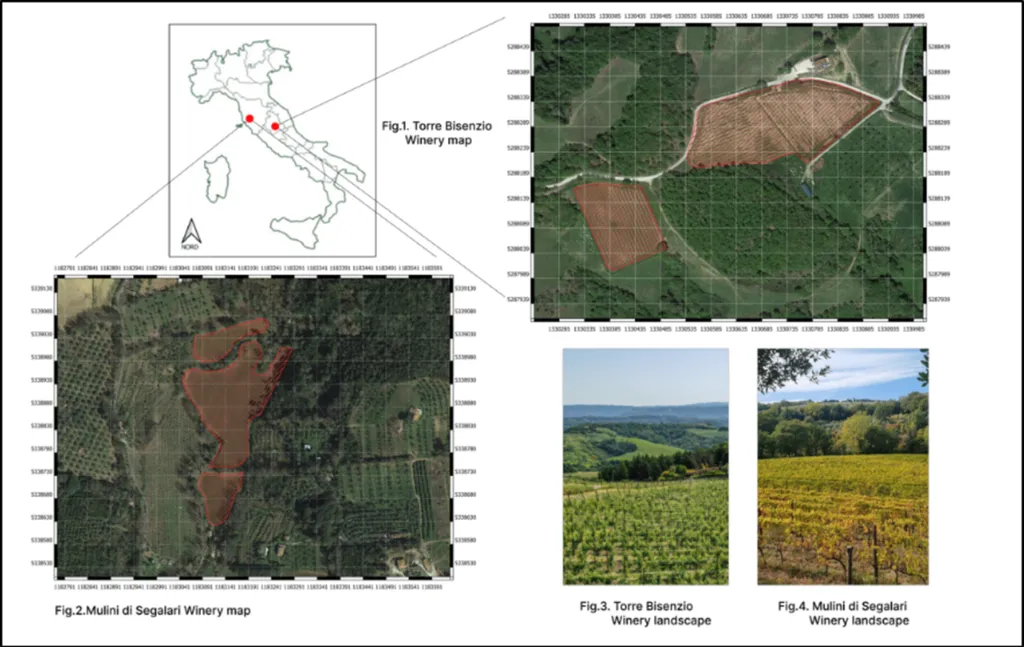
In the rolling vineyards where terroir meets technology, a new study is making waves, promising to reshape how viticulturists approach soil management. Published in *Agronomy*, the research led by Thomas M. Koutsos from the Laboratory of Remote Sensing, Spectroscopy and GIS at Aristotle University of Thessaloniki, Greece, introduces a novel framework for delineating vineyard management zones using advanced statistical techniques.
Soil heterogeneity is no secret to vineyard managers; it’s a well-known factor that can make or break a harvest. However, the challenge lies in translating this complexity into actionable insights. Koutsos and his team tackled this issue head-on by applying Principal Component Analysis (PCA) and Hierarchical Cluster Analysis (HCA) to soil data from both topsoil and deeper soil layers. “By analyzing both the top and integrated soil layers, we can gain a more comprehensive understanding of the spatial variability that affects vine performance,” Koutsos explains.
The study’s methodology is as intriguing as its implications. PCA was first used to identify the soil variables contributing most to spatial variability. Then, HCA classified soil samples into meaningful clusters based on their PCA scores. The result? A detailed map that visually represents the geographical extent of these factors and clusters, overlaid with key grape characteristics. This isn’t just about understanding soil variability; it’s about turning data into a strategic tool for precision viticulture.
For the agriculture sector, the commercial impacts are significant. Precision viticulture isn’t just a buzzword; it’s a game-changer. By delineating functional management zones, vineyard managers can tailor their practices to specific areas, optimizing resource use and potentially boosting yields. “This approach allows for more targeted interventions, whether it’s irrigation, fertilization, or pest management,” Koutsos notes. “It’s about working smarter, not harder.”
The study’s findings suggest that analyzing the integrated soil layer provides critical information for defining these management zones. This could lead to more efficient use of resources, reduced environmental impact, and ultimately, higher-quality grapes. As the agriculture sector continues to embrace technology, such data-driven approaches are likely to become standard practice.
The research also opens the door to future developments. As Koutsos points out, “This framework can be adapted and refined as new data becomes available. It’s a flexible tool that can evolve with the needs of the industry.” This adaptability is crucial in an era where climate change and other factors are constantly reshaping the agricultural landscape.
In the end, this study is more than just a scientific breakthrough; it’s a testament to the power of data in transforming traditional practices. As viticulturists increasingly adopt precision agriculture techniques, the insights from this research could pave the way for more sustainable and productive vineyards. And in a world where every drop of water and every gram of fertilizer counts, that’s a harvest worth celebrating.