
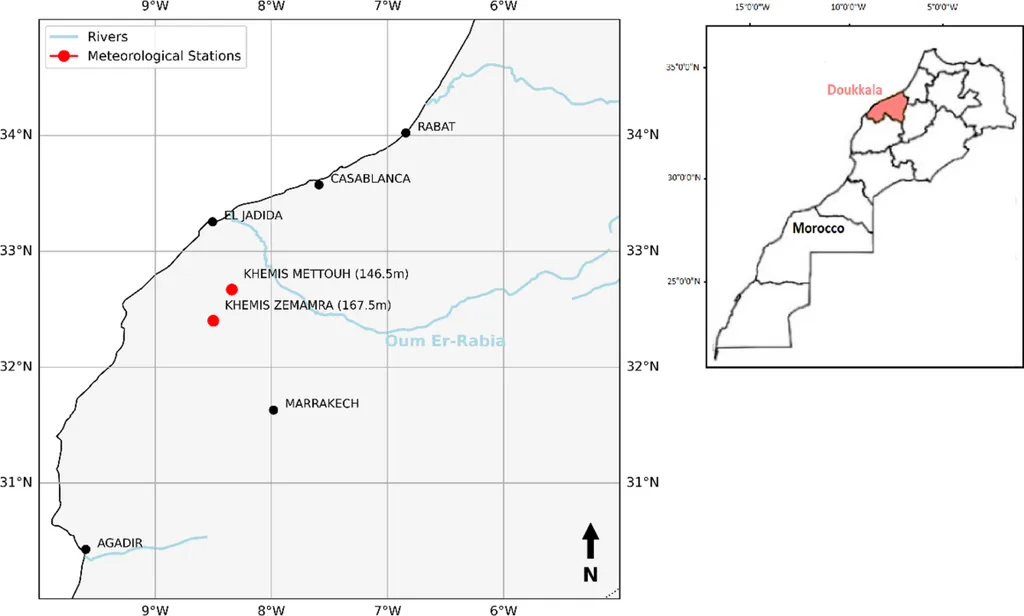
In the heart of Morocco’s semi-arid Tensift Al-Haouz region, a critical challenge for farmers and water managers is accurately measuring evapotranspiration (ET)—the process by which water is transferred from the land to the atmosphere. This measurement is vital for optimizing irrigation and managing water resources effectively. A recent study published in the journal *Atmosphere* has shed light on the performance of various remote sensing products in estimating ET, offering valuable insights for the agriculture sector.
The study, led by Yassine Manyari of the International Water Research Institute (IWRI) at Mohammed VI Polytechnic University, evaluated five high-resolution global ET products against ground measurements from eddy covariance (EC) towers. These towers provide reliable, localized data on water vapor exchange between the land and atmosphere. The research spanned from 2006 to 2019, providing a comprehensive assessment of how well remote sensing products can capture the nuances of ET in a semi-arid climate.
The findings reveal significant differences in the accuracy of the ET products. The PMLv2 product emerged as the top performer, with the highest correlation (R² up to 0.65) and the lowest root mean square error (RMSE as low as 0.4 mm/day) when compared to EC measurements. “PMLv2’s superior performance suggests it could be a game-changer for farmers and water managers in semi-arid regions,” Manyari noted. “Its ability to accurately reflect seasonal ET patterns and respond to rainfall and irrigation inputs makes it a reliable tool for water resource management.”
Following PMLv2, the WaPOR and SSEBop products also showed promising results, capturing seasonal ET patterns with moderate bias. These products achieved correlation coefficients around 0.3 to 0.5 and biases ranging from 20% to 30%. In contrast, the ETMonitor and MOD16 products underperformed, with larger errors and substantial underestimation biases, particularly in irrigated sites.
The implications of this research are substantial for the agriculture sector. Accurate ET measurements are crucial for optimizing irrigation practices, which can lead to significant water savings and improved crop yields. “For farmers, having access to reliable ET data means they can make more informed decisions about when and how much to irrigate,” Manyari explained. “This not only conserves water but also enhances productivity, which is essential in water-limited regions like Tensift Al-Haouz.”
The study also highlights the importance of algorithmic differences in ET products. The superior performance of PMLv2, WaPOR, and SSEBop suggests that these models are better equipped to handle the complexities of semi-arid environments. This insight could guide future developments in remote sensing technologies, encouraging the refinement of algorithms to improve accuracy and reliability.
As the agriculture sector continues to grapple with the challenges of climate change and water scarcity, the findings from this research offer a beacon of hope. By leveraging advanced remote sensing products like PMLv2, farmers and water managers can better navigate the intricacies of water resource management, ensuring sustainable and productive agricultural practices. The study, published in *Atmosphere* and led by Yassine Manyari of the International Water Research Institute (IWRI) at Mohammed VI Polytechnic University, underscores the critical role of accurate ET measurements in shaping the future of agriculture in semi-arid regions.